 Reading Time: 34 minutes
Six cattle lay dying in the lower pasture when Cora Jenkins arrived at Broken Spur Ranch. Wade Callahan reached for his rifle. Cora caught his arm.
“They’re still breathing.” Wade stared at her. “Barely.” Her dark eyes did not leave the swollen steer lying on its side. “That means they’re alive.”
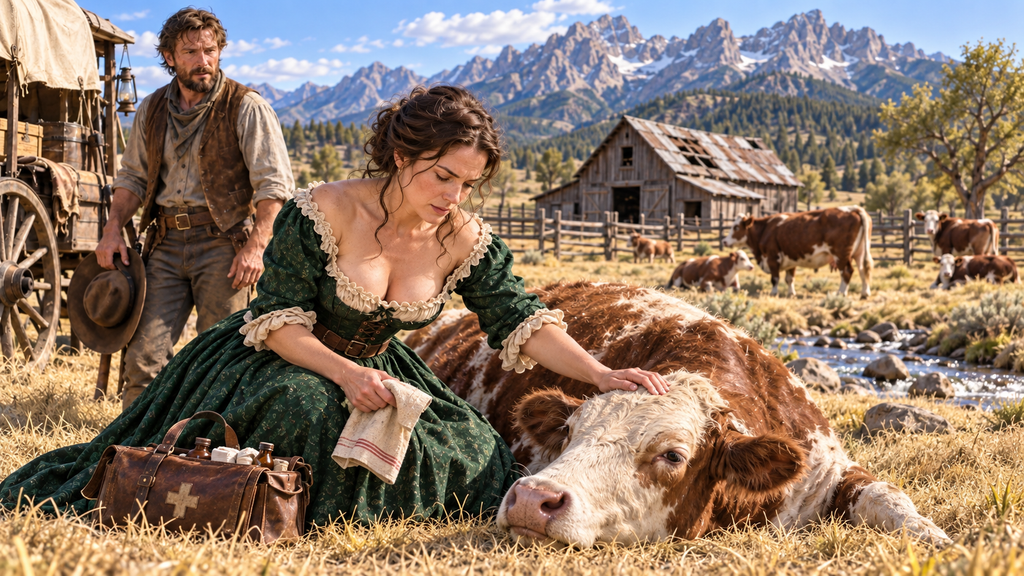
Then the woman he had known for less than four hours opened the worn leather roll hanging from her belt and held out her hand.
“Give me your sharpest knife.”
Wade did not move.
Cora looked at him.
“And find me a hollow tube.”
That was the moment Wade Callahan understood something he should have realized the instant she stepped off the train.
Cora Jenkins had not traveled halfway across America because she needed someone to rescue her.
She had come west because she already knew how to survive.
And before the sun went down over Broken Spur Ranch, Wade would discover that his strange new wife might be the only person capable of saving everything he had left.
Three months earlier, Wade had eighty-three cattle.
A year earlier, Broken Spur Ranch had been profitable.
Five years earlier, his father had still been alive.
Back then, the creek had run deep enough for Wade to kneel beside it and splash cold water across his face after a fourteen-hour day.
The barn roof had been straight.
The south pasture had been green.
There had been laughter in the house.
His mother’s roses had still bloomed beside the porch.
Then life had begun taking things from him one piece at a time.
First his mother.
Then his father.
Then the rain.
Then the cattle.
By late August, Wade had fifty-nine animals remaining.
The creek had become a muddy ribbon twisting through cracked earth.
The barn leaned slightly to the east.
Two fences needed replacing.
His account at the feed store had been suspended.
And the bank had sent two notices.
The second one had been painfully clear.
If Wade Callahan failed to make payment before October first, Broken Spur Ranch could be seized.
He had read the letter at the kitchen table alone.
Then he had folded it carefully, placed it beneath his father’s old Bible, and spent the rest of the night staring through the window.
Broken Spur was not simply land.
His grandfather had broken the first soil there.
His father had built the north barn by hand.
His mother had planted roses beside the porch because, as she used to say, “A hard life needs something beautiful growing in it.”
Wade had buried both of them beneath a cottonwood tree on the hill.
There were places a man could sell.
There were places he could abandon.
Broken Spur was neither.
He would lose himself before he willingly lost the ranch.
But determination did not pay bank notes.
It did not bring rain.
It did not revive dying cattle.
And it certainly did not make an empty house feel like a home.
So one lonely night, after three glasses of whiskey and an argument with himself that lasted until nearly midnight, Wade wrote an advertisement.
Rancher, thirty-six, seeks practical wife willing to build life in western territory. Hard work. Modest means. Honest intentions.
He read it four times.
Then added:
Must not be afraid of cattle.
He almost tore it up.
Instead, he mailed it.
For two weeks, there was nothing.
Then a letter arrived from Chicago.
The handwriting was strong.
Direct.
There were no flowers drawn around the edges.
No poetry.
No questions about dresses or dances or whether Wade owned a piano.
The woman introduced herself as Cora Jenkins.
Thirty-three years old.
Unmarried.
Employed fifteen years in the Chicago stockyards.
Capable of cooking, bookkeeping, handling livestock, sewing wounds, driving a wagon, repairing basic equipment, and “tolerating difficult men when absolutely necessary.”
Wade read that line twice.
Then he laughed.
It was the first time he had laughed in months.
Three letters became nine.
Nine became seventeen.
Cora never wrote like a woman trying to impress a stranger.
She wrote about work.
Weather.
Cattle.
The price of grain.
Books she liked.
Her dislike of people who talked during sermons.
Once, she asked him why he wanted a wife.
Wade stared at the paper for an hour before answering truthfully.
Because I am tired of coming home to silence.
Her reply arrived eleven days later.
Silence does not bother me. Loneliness does. They are not the same thing.
That sentence stayed with him.
Eventually, Wade sent train fare.
And on September third, he stood at the little station in Red Hollow waiting for a woman he had never seen except in one faded photograph.
The train arrived beneath a cloud of smoke and dust.
Families gathered near the platform.
Porters unloaded trunks.
A businessman stepped down.
Then an elderly couple.
Then a woman appeared in the doorway.
Wade knew immediately.
Cora Jenkins was taller than he expected.
Broad-shouldered.
Straight-backed.
She wore a dark traveling dress without unnecessary decoration and sturdy brown boots.
A weathered canvas trunk hung from one hand.
A rolled leather butcher’s kit hung from the other.
A pale scar crossed the left side of her jaw, beginning beneath her ear and disappearing near her chin.
Another white line marked one knuckle.
She stepped onto the platform.
Her eyes found Wade.
For several seconds, neither spoke.
Wade suddenly became painfully aware that his shirt was faded, his boots were dusty, and he had cut himself shaving.
Cora examined him from hat to boots.
Then she said, “You look worse than your photograph.”
Wade blinked.
A laugh escaped him before he could stop it.
Cora’s mouth curved slightly.
“I suppose that means I found the right man.”
“You must be Cora.”
“I certainly hope so. Otherwise I’ve traveled a very long way under the wrong name.”
He took her trunk.
It was heavier than expected.
“What did you pack in here?”
“Things I need.”
“It feels like an anvil.”
“There might be one.”
Wade looked at her.
Cora kept a perfectly serious expression for three seconds.
Then one corner of her mouth lifted.
He liked her immediately.
That frightened him.
Because liking someone meant having something else to lose.
They walked toward the wagon.
Wade had promised himself he would tell her the truth before they reached the ranch.
He had not included everything in his letters.
Not because he wanted to deceive her.
Because each month had been worse than the last.
The ranch she had agreed to join barely existed anymore.
At the wagon, he finally stopped.
“There’s something you should know.”
Cora set one hand on the wooden wheel.
“That sounds promising.”
“I have nine dollars and forty cents.”
She stared at him.
“Total?”
“After your train fare.”
Silence.
Wade prepared himself.
He had imagined this moment many times.
Cora would become angry.
She would accuse him of deception.
She might demand he purchase a ticket back east.
He had already decided he would sell his saddle if necessary to get her home.
Instead, Cora climbed into the wagon.
Wade remained beside the wheel.
“You aren’t angry?”
“I worked fifteen years in Chicago stockyards.”
She settled on the seat.
“I’ve eaten beans three meals a day and considered myself fortunate there were beans.”
“That isn’t exactly an answer.”
Cora looked down at him.
“Do you still want a wife?”
Wade swallowed.
“Yes.”
“Then drive.”
And somehow, that was that.
Three hours later, Broken Spur appeared over the ridge.
Wade watched Cora carefully.
He saw everything she saw.
The weathered house.
The leaning fence.
The sagging barn roof.
The dry field.
The creek reduced to mud.
He waited for disappointment.
Cora said nothing.
Then her eyes narrowed.
“What’s wrong with those cattle?”
Wade turned.
Six animals lay scattered across the lower pasture.
One steer kicked weakly.
Another lay completely still except for the desperate rise and fall of its ribs.
Wade jumped from the wagon before it stopped moving.
“No.”
He ran.
Cora followed.
The first steer’s belly was swollen.
Its mouth hung open.
Wade felt something inside himself collapse.
“Bloat.”
He had seen it before.
Sometimes an animal could be saved.
Sometimes not.
But six at once?
He looked at his remaining herd.
Every animal mattered now.
Losing six more would destroy him.
His hand moved toward his rifle.
It was kinder than letting them suffer.
Cora caught his sleeve.
“They’re still breathing.”
“Barely.”
“That means alive.”
“Cora—”
“Knife.”
He stared.
“What?”
“Your sharpest knife.”
“I’m not letting you—”
“And I need a hollow tube.”
Wade looked into her face.
There was no panic there.
No fear.
Only concentration.
“You know what you’re doing?”
“I know what happens if we waste time arguing.”
That was enough.
Wade ran.
Minutes later, he returned with a lantern, a narrow piece of cleaned metal tubing, and his hunting knife.
Cora was already examining the steer.
“Hold its head.”
“What are you going to do?”
“Help it breathe.”
She moved with the calm confidence of someone who had spent years around suffering animals.
Wade obeyed.
Together they relieved the pressure in the worst animal, then worked through the others.
Not all responded.
But four did.
One eventually staggered upright.
Another rolled onto its chest.
Wade stared as if witnessing a resurrection.
Cora wiped her hands on a cloth.
“Don’t celebrate yet.”
“You just saved them.”
“No.”
She looked toward the others.
“I bought them time.”
That distinction would matter.
Before darkness fell, Cora began walking the pasture.
She examined feed.
Dung.
Water.
The cattle’s mouths.
Their eyes.
Their breathing.
Wade followed.
Finally, she approached the creek.
She crouched beside the muddy edge and pressed her fingers into the dark residue.
Then she smelled it.
Her expression changed.
“What?”
Cora stood.
“Show me where you store feed.”
“The cattle need—”
“Show me.”
Something in her tone made him move.
They reached the feed shed.
Cora opened a sack.
Then another.
She scooped grain into her palm.
Smelled it.
Crushed some between her fingers.
“Where did this come from?”
“Morgan’s General Supply.”
Her eyes lifted.
“Morgan?”
“Caleb Morgan.”
“Who is he?”
Wade exhaled.
“The man who wants my ranch.”
Cora looked toward the pasture.
Then back at the feed.
“How badly?”
“He’s been trying to buy Broken Spur for years.”
“How often?”
“Every few months.”
“Recently?”
“Twice since spring.”
Cora dropped the grain.
“What does he own?”
“Most of Red Hollow.”
“What does that mean?”
“The bank. General store. Lumber yard. Half the freight company. Some grazing land north of here.”
Cora became still.
“He owns your bank?”
“He controls it.”
“And your feed comes from his store.”
“Yes.”
“And he wants this land.”
“Yes.”
Cora slowly wiped her palm against her skirt.
“You don’t have bad luck, Wade.”
A chill moved through him.
“What are you saying?”
She looked directly at him.
“I’m saying somebody is helping your ranch die.”
Wade slept less than an hour that night.
Cora slept in the small room across from his.
They had not discussed the sleeping arrangements.
There had been no need.
Whatever their marriage became, it would not begin with obligation.
Not after the look he had seen in her eyes whenever a man moved too quickly near her.
He lay awake listening to the unfamiliar sound of another person breathing inside the house.
At some point near dawn, he rose.
Cora was already outside.
She stood beside the cattle pen with her sleeves rolled above her elbows.
“You always wake up this early?”
he asked.
She did not turn.
“You always ask obvious questions?”
“I’m trying to get to know my wife.”
“Ask better questions.”
He leaned against the fence.
“Fine.”
He thought for a moment.
“Why did you answer my advertisement?”
Her hands stopped moving.
Only briefly.
But he noticed.
“I needed somewhere else to go.”
“Why here?”
“Because Chicago was too close to Chicago.”
He almost smiled.
Then saw her expression.
“Meaning?”
“Sometimes a person needs to get far enough away from the place that hurt them.”
Wade’s gaze moved toward the scar along her jaw.
“What happened?”
Cora’s shoulders stiffened.
“Which part?”
“The scar.”
Silence.
“Chicago.”
Just one word.
But the way she said it ended the conversation.
Wade nodded.
He understood boundaries.
He had built plenty of his own.
Cora returned to examining the cattle.
After several minutes, she said, “Yesterday wasn’t ordinary bloat.”
“I figured that.”
“They’re weak.”
“From poison?”
“Something introduced gradually. Enough to make them sick. Probably not enough to kill all of them immediately.”
“Why?”
“Because dead cattle lose you money.”
She turned.
“Sick cattle make you desperate.”
Wade felt the words settle inside him.
“And desperate men sell.”
Cora nodded.
He looked across Broken Spur.
The answer seemed ridiculous.
Too deliberate.
Too cruel.
“No.”
“What?”
“Caleb is a bastard, but poisoning livestock?”
“Why not?”
“Because people aren’t monsters.”
Something changed in Cora’s eyes.
“You’ve worked with cattle too long.”
“Meaning?”
“Animals generally hurt something because they’re frightened, hungry, injured, or protecting themselves.”
She stepped closer.
“People can hurt something simply because it stands between them and what they want.”
Wade looked away.
Near the feed shed, a print marked the soft dirt.
He crouched.
A work boot.
Deep heel.
Worn outer edge.
Wade knew that boot pattern.
Caleb’s hired men wore them.
Bought in bulk from Morgan’s own general store.
Before he could speak, hooves sounded on the road.
Three riders approached.
Caleb Morgan rode in the center.
He looked exactly as he always did.
Expensive dark coat.
Clean gloves.
Silver watch chain.
The appearance of a respectable businessman.
The eyes of a man who measured everything in ownership.
Caleb stopped at the fence.
“Well.”
His gaze shifted to Cora.
“The famous bride.”
Wade stepped forward.
“Leave.”
“I only came to welcome your new wife.”
“You’ve done it.”
Caleb smiled.
“Still friendly as ever.”
Then he turned toward Cora.
“Mrs. Callahan, has Wade explained your situation?”
“What situation?”
“This ranch is finished.”
His voice was gentle.
Almost sympathetic.
“Your husband is drowning.”
Wade’s hands curled.
“Careful.”
Caleb ignored him.
“I’m offering you both a dignified exit. Enough money to start somewhere else.”
Cora folded her arms.
“You mean you want to buy the ranch.”
“I prefer to think of it as buying your future.”
“You mean stealing his past.”
Caleb’s smile disappeared.
Only for a heartbeat.
Then it returned.
“You’re direct.”
“I spent fifteen years around slaughterhouses.”
She looked him over.
“I learned not to waste time decorating unpleasant things.”
Wade nearly smiled.
Caleb did not.
“You should be careful, Mrs. Callahan.”
Cora’s expression remained calm.
“About what?”
“People who come west sometimes discover it is less welcoming than they imagined.”
She stepped toward his horse.
“I didn’t come because I expected welcoming people.”
Her eyes held his.
“I came because I’m very familiar with desperate men.”
Something flickered across Caleb’s face.
Recognition?
Fear?
Wade could not tell.
Then Caleb’s eyes dropped toward the scar on Cora’s jaw.
And for the first time, Caleb Morgan looked genuinely unsettled.
“You.”
The word was quiet.
Cora heard it.
So did Wade.
Caleb recovered quickly.
He turned his horse.
“October first is coming, Callahan.”
Then the three riders disappeared down the road.
Wade turned toward Cora.
“What was that?”
“What?”
“He recognized you.”
“No.”
“He did.”
Cora looked away.
Wade stepped closer.
“Cora.”
“He was surprised.”
“Why?”
She remained silent.
He felt something cold enter his chest.
“There’s something you aren’t telling me.”
“Yes.”
The answer shocked him.
Cora looked at him.
“There are several things I’m not telling you.”
“Why?”
“Because I met you yesterday.”
The honesty hurt less than a lie would have.
Still, it hurt.
“You married me.”
“Yes.”
“That normally involves trust.”
“No.”
Her voice softened.
“Marriage is a promise to build trust. It isn’t magic, Wade.”
He stared at her.
She continued.
“You don’t trust me either.”
“I brought you into my home.”
“That isn’t the same thing.”
He had no answer.
Because she was right.
Again.
And Wade was discovering that being married to Cora Jenkins meant hearing truths he had spent years avoiding.
Over the next three days, Broken Spur changed.
Not because rain came.
Not because the bank forgave its debt.
Not because the ranch magically repaired itself.
The problems remained.
But life returned to the property.
Cora cleaned every trough.
She separated questionable feed.
She boiled tools.
She repaired the gate beside the western paddock.
She reorganized the kitchen within twenty-four hours because, according to her, Wade stored flour “like a man expecting mice to pay rent.”
She cooked beans.
Then complained that he had exaggerated when he said he could cook.
“I can cook.”
“No.”
“I’ve fed myself for seven years.”
“That proves survival. Not cooking.”
He found himself laughing more often.
It surprised him every time.
One afternoon, he found Cora standing on the barn roof.
“Get down.”
She looked over the edge.
“Why?”
“Because you’re twenty feet in the air.”
“Your roof is leaking.”
“That doesn’t mean you have to fall through it.”
“Then climb up and help me.”
Wade stared.
“Cora.”
“You said you wanted a practical wife.”
“I didn’t expect a suicidal one.”
She smiled.
The sight of it stopped him.
Cora did not smile often.
When she did, she looked younger.
Softer.
Almost like the woman she might have been before Chicago placed that scar on her face.
He climbed the ladder.
They spent two hours patching shingles.
At one point, Cora slipped.
Only slightly.
Wade caught her around the waist.
She froze.
He froze too.
For one suspended moment, her body was against his.
Her breath stopped.
Wade immediately loosened his hands.
“Sorry.”
Cora stared at him.
He stepped back.
“I won’t—”
“I know.”
Her voice was barely audible.
Something passed between them.
Not romance exactly.
Not yet.
Something more fragile.
Trust.
That evening, they sat on the porch beneath a sky crowded with stars.
Cora stared upward.
“I forgot there were this many.”
“Stars?”
“You can see them in Chicago.”
She wrapped both hands around her coffee cup.
“You just have to find them through the smoke.”
“Do you miss the city?”
“No.”
Too fast.
Wade let the silence remain.
He had learned that pushing Cora was the fastest way to make her disappear inside herself.
So he waited.
Eventually, she spoke.
“I was nineteen when I started in the stockyards.”
Wade said nothing.
“My mother had died the winter before. I needed wages.”
She looked across the dark pasture.
“At first they put me wherever nobody wanted to work. Cleaning. Records. Sick pens. I learned cattle because I had to.”
“That’s where you learned what you did the other day?”
“Yes.”
She touched the scar on her jaw without seeming to realize it.
“You learn quickly when mistakes make living things suffer.”
Wade watched her hand.
“Tell me.”
Cora lowered it.
“About what?”
“Chicago.”
The wind moved her hair.
After a long silence, she said, “His name was Thomas Bell.”
Wade waited.
“He owned packing houses.”
“Your employer?”
“Eventually.”
Her voice grew distant.
“Bell liked people thinking he had built everything himself. He hadn’t. He built wealth by finding people too poor to refuse him.”
“What happened?”
“I discovered animals arriving sick.”
Wade’s brow tightened.
“Disease?”
“Sometimes.”
She looked at him.
“Some should have been destroyed immediately. Instead, records were altered. Inspectors were paid. Meat was processed anyway.”
Wade felt sick.
“You reported it.”
“Yes.”
“To whom?”
“Anyone who would listen.”
“And?”
Cora gave a humorless laugh.
“Bell owned politicians. Inspectors. Policemen. Newspaper men.”
Her eyes hardened.
“Suddenly I became an unstable woman inventing stories.”
Wade’s jaw tightened.
“Then?”
“One night, two men followed me home.”
The porch seemed suddenly too small.
“They wanted the ledger I had stolen from Bell’s office.”
“You stole evidence?”
“I copied what I could. Took one ledger.”
“And they attacked you.”
Cora nodded.
One finger traced the edge of the scar.
“One held me. The other used a knife.”
Wade felt heat rise behind his eyes.
“What happened to them?”
“I made sure one couldn’t have children.”
Wade stared.
Cora took a sip of coffee.
“The other lost three teeth.”
Despite his anger, Wade almost laughed.
“You escaped.”
“Yes.”
“Did Bell go to prison?”
“No.”
“Why?”
“The ledger disappeared.”
“How?”
“The man I trusted to deliver it vanished.”
She looked at him.
“I left Chicago shortly afterward.”
Wade stared into the darkness.
“Thomas Bell still alive?”
“Yes.”
His voice became dangerously quiet.
“Good.”
Cora turned toward him.
“For what?”
“So he can regret it.”
Something softened in her face.
“That sounds romantic in a very disturbing way.”
“I’m trying.”
This time, she laughed.
A real laugh.
And Wade thought it might have been the most beautiful sound Broken Spur had heard in years.
The attack came before sunrise the next morning.
A violent crash woke Wade.
Then cattle screaming.
He reached the barn with Cora only seconds behind him.
One cow kicked against the stall.
Another had broken through a divider.
Feed sacks lay split across the floor.
Grain covered the boards.
Cora stopped instantly.
“Don’t touch anything.”
Wade followed her gaze.
Near the back door, a small glass bottle lay beneath the hay.
They both saw it.
Cora crouched but did not touch it.
“Someone got careless.”
Wade’s blood went cold.
An hour later, Sheriff Daniel Hayes arrived.
He had been one of Wade’s father’s closest friends.
Gray-haired now.
Broad around the middle.
But his eyes were still sharp.
He examined the bottle, sacks, and back entrance.
“Who are you accusing?”
“Caleb Morgan.”
Hayes sighed.
“Wade.”
“He wants the ranch.”
“That isn’t proof.”
“The feed came through his store.”
“Still not proof.”
“The boot prints—”
“Half the county buys boots there.”
Wade clenched his jaw.
Cora stepped forward.
“There’s residue in that bottle.”
Hayes looked at her.
“And you are?”
“Cora Callahan.”
A faint smile appeared.
“So you’re the famous Chicago bride.”
Wade frowned.
“How does everybody already know?”
Hayes shrugged.
“Red Hollow has nineteen hundred people and no theater.”
Cora pointed at the bottle.
“Have someone examine it.”
“I will.”
“And test the feed.”
“If I can.”
She looked unimpressed.
Hayes raised both hands.
“Mrs. Callahan, Caleb Morgan owns half the town. That doesn’t mean I work for him.”
“I didn’t say you did.”
“You thought it loudly.”
Wade coughed to hide a laugh.
Hayes became serious.
“If Caleb is involved, you two need to be careful.”
“Why?”
“Because men like Caleb don’t panic while they’re winning.”
His eyes moved from Wade to Cora.
“They panic when they realize they might lose.”
That afternoon, Wade found the box.
He was repairing a loose board inside the old storage room when his hammer struck something beneath the floor.
Metal.
He pried up the plank.
A rusted tin box sat below.
His father’s initials were carved into the lid.
W.C.
William Callahan.
Wade stopped breathing.
He carried the box to the workbench.
Inside were letters.
Dozens.
Some from Caleb Morgan.
Some from businesses Wade did not recognize.
Some dated more than ten years earlier.
He opened one.
William, your refusal is becoming inconvenient. The western packing arrangement requires uninterrupted control over the rail corridor. Broken Spur occupies the only usable water access for twelve miles. Sell now and save us both trouble.
Signed:
C. Morgan
Wade opened another.
Thomas Bell remains interested.
Bell.
His stomach tightened.
Thomas Bell.
Cora’s Thomas Bell.
He opened letter after letter.
The truth became clearer.
Years earlier, Caleb Morgan and Thomas Bell had been attempting to establish a private cattle supply route through the region.
Broken Spur stood between their northern grazing properties and the rail line.
They needed Wade’s water rights.
His land.
His access road.
His father had refused.
Threats followed.
Then Wade found the final envelope.
The handwriting on the front stopped his heart.
Miss Cora Jenkins.
He stared at it.
His father had written to Cora.
Years before Wade had placed his advertisement.
With shaking hands, he unfolded the letter.
Dear Miss Jenkins,
If you receive this, I fear I was unable to finish what I started.
Wade’s vision blurred.
He kept reading.
What you uncovered in Chicago reaches farther west than you know. Thomas Bell’s operation is connected to Caleb Morgan. I have collected records showing fraudulent cattle purchases, poisoned grazing claims, bribery, and deliberate destruction of livestock belonging to men who refuse to sell.
Wade lowered the letter.
His pulse thundered.
Then he read the next line.
If anything happens to me, you may be the only person who can save my son and Broken Spur Ranch.
The storage room door opened.
“Wade?”
Cora entered.
She stopped.
Saw the letter.
And turned pale.
“Where did you find that?”
Wade looked at her.
“You knew my father.”
Silence.
“Cora.”
Her eyes closed.
“I was hoping those were gone.”
Something inside Wade cracked.
“You didn’t come here because of my advertisement.”
Cora did not answer.
“You already knew who I was.”
“Yes.”
One word.
It struck harder than any lie.
“You came because my father asked you.”
“Not exactly.”
“Then explain it.”
Cora reached into the inner pocket of her coat.
She removed an old photograph.
A younger Cora stood beside William Callahan.
Beside them stood a heavier man in a city coat.
Thomas Bell.
Wade stared.
“My father knew him.”
“He was investigating him.”
“My father was a rancher.”
“Your father was a stubborn man who realized someone was poisoning cattle, forcing ranchers into bankruptcy, and buying their land through Caleb Morgan.”
Wade looked back at the letters.
“How did he know you?”
“I wrote to ranchers whose names appeared in Bell’s private books.”
“And my father answered.”
“Yes.”
“Why didn’t you tell me?”
“Because when your father died, I believed the evidence died with him.”
Wade’s throat tightened.
“He fell from a horse.”
Cora’s eyes filled with something Wade had never seen there.
Pity.
“I’m sorry.”
He stepped back.
“What?”
“Wade…”
“No.”
His voice sharpened.
“Say it.”
Cora looked directly at him.
“Your father didn’t die because of an accident.”
The room became silent.
Wade could hear the wind outside.
The creak of timber.
His own breathing.
“He was murdered.”
For several seconds, Wade did nothing.
Then he laughed once.
A broken sound.
“No.”
Cora reached toward him.
He pulled away.
“No.”
“Wade.”
“I found him.”
The words escaped before he could stop them.
Cora froze.
“I found him at the bottom of Miller’s Ridge.”
His voice cracked.
“His horse came home alone.”
Cora said nothing.
“I climbed that ridge in the rain. I carried him back myself.”
His chest tightened painfully.
“The doctor said his neck broke in the fall.”
“He may have been pushed.”
Wade slammed one fist into the workbench.
“May have?”
Cora flinched.
He saw it.
Immediately, his anger changed direction.
“I’m sorry.”
She remained still.
“I’m not angry with you.”
“You have every right to be.”
“I’m angry because you knew.”
“I suspected.”
“You knew enough to marry me under false pretenses.”
Cora’s face tightened.
“I answered your advertisement because I wanted to.”
“After my father asked you to save me?”
“Years earlier.”
“You never thought that mattered?”
“Of course it mattered.”
“Then why hide it?”
Cora’s voice broke.
“Because I was afraid.”
The words stopped him.
Cora Jenkins rarely admitted fear.
She looked down.
“Your father believed me when nobody else did.”
Her eyes shone.
“He wrote letters. Gathered evidence. Risked his life for a woman he had never met.”
She swallowed.
“When I learned he died, I blamed myself.”
Wade’s anger faltered.
“Then your advertisement appeared.”
She laughed weakly.
“Of all the newspapers in Chicago, someone left that one on the table beside me.”
She looked at him.
“I saw your name.”
“Callahan.”
“I knew immediately.”
“Why answer?”
“Because I wanted to know whether his son was worth what his father had risked.”
That hurt.
Wade looked away.
“And?”
Cora stepped closer.
“I arrived expecting a desperate rancher.”
Her voice softened.
“I found a stubborn, miserable man with terrible coffee who would rather lose everything than abandon the graves of people he loved.”
Wade almost smiled despite himself.
“And I found a man who held a dying animal because a woman he barely knew told him to trust her.”
She moved another step closer.
“I stayed because of you, Wade.”
His eyes met hers.
“Not your father.”
She touched her chest.
“You.”
For a long time, neither spoke.
Then Wade looked at the letters.
“We finish what he started.”
Cora’s expression hardened.
“Yes.”
They spent the night reading.
The letters told a story that stretched across fifteen years.
Caleb Morgan purchased distressed ranches.
Thomas Bell’s companies acquired cattle from them at artificially low prices.
When ranchers refused to sell, strange things happened.
Wells became contaminated.
Livestock sickened.
Barns burned.
Loans were suddenly recalled.
Wade’s father had discovered enough patterns to become suspicious.
Then he began collecting names.
Dates.
Receipts.
Shipping records.
One document mattered more than the rest.
A reference to an account ledger kept inside Caleb Morgan’s office.
A ledger documenting payments to inspectors, bank officers, hired men, and Thomas Bell.
If they found that ledger, Caleb could not buy his way out.
Wade looked at Cora.
“We go to town.”
“No.”
“What?”
“We need a plan.”
“My father was murdered.”
“And if you charge into Caleb’s office waving a rifle, your father will remain murdered and you’ll be in jail.”
Wade paced.
“So we do nothing?”
“I didn’t say that.”
“Then what?”
Cora spread the papers across the table.
“We make him believe he won.”
Wade stopped.
“He wants Broken Spur.”
“Yes.”
“So?”
“So we offer to sell.”
Wade stared at her as though she had slapped him.
“No.”
“Listen.”
“No.”
“Wade.”
“I will burn this ranch before I hand it to Caleb Morgan.”
“That is exactly why he’ll believe you only if you look completely defeated.”
He understood.
Slowly.
“You want him careless.”
“Yes.”
“He’ll bring papers.”
“He might bring records.”
“And while he thinks we’re signing?”
“We learn where he keeps the ledger.”
Wade sank into the chair.
“That is either brilliant or suicidal.”
Cora nodded.
“Most useful plans are uncomfortable.”
He studied her.
“You’ve done this before.”
“Not this exact thing.”
“That isn’t reassuring.”
“It wasn’t meant to be.”
The next morning, Wade rode into Red Hollow alone.
He entered Morgan Bank wearing the same shirt he had worked in the previous day.
Caleb sat behind a polished desk.
The office was designed to make ordinary men feel poor.
Mahogany furniture.
Leather chairs.
Heavy curtains.
A silver decanter.
Caleb leaned back.
“Well.”
Wade removed his hat.
“I’m ready.”
Caleb’s eyebrows rose.
“For?”
“To sell Broken Spur.”
The silence was delicious.
Caleb studied him.
“What changed?”
Wade looked toward the floor.
He let exhaustion show.
That part required little acting.
“My cattle are sick.”
“Yes.”
“The bank note is due.”
“Yes.”
“My wife thinks we should leave.”
That lie hurt strangely.
Caleb smiled.
“Smart woman.”
Wade lifted his eyes.
“I want enough to clear the note and buy someplace east.”
“How much?”
They argued.
Wade deliberately accepted less than the ranch was worth.
Caleb struggled to hide his pleasure.
Finally, he stood and held out his hand.
“Tomorrow afternoon.”
“What?”
“We sign tomorrow.”
Wade shook his hand.
Caleb’s palm was soft.
“Bring your wife. Since you’re married, she’ll need to sign the transfer.”
Wade nodded.
As he turned toward the door, he saw Caleb reach toward a key hanging from his watch chain.
A tiny brass key.
Caleb noticed his gaze and slipped it into his vest.
Wade continued walking.
But he had seen where Caleb looked immediately afterward.
A painting behind the desk.
Behind the painting, a small outline showed in the wallpaper.
A safe.
That evening, Cora listened.
“The ledger is in the safe.”
“Probably.”
“And Caleb carries the key.”
“Yes.”
She considered it.
“We still need the combination.”
Wade looked at her.
“What?”
“You’re going to hate this.”
“I already hate most plans involving you.”
“Tomorrow, you keep Caleb busy.”
“And you?”
“I get into the safe.”
“How?”
Cora smiled faintly.
“I worked in Chicago.”
“That is not an answer.”
“It’s all you’re getting.”
He stared at her.
Then something shifted.
“Cora.”
“Yes?”
“If tomorrow goes wrong…”
“Don’t.”
“I need to say this.”
Her smile disappeared.
He stepped closer.
“I spent years thinking Broken Spur was the only thing I had left.”
Cora’s eyes softened.
“It isn’t anymore.”
Her breath caught.
Wade continued before courage abandoned him.
“I know this marriage started strangely.”
“That may be the greatest understatement in western history.”
He almost laughed.
“But I don’t want you here because of my father.”
“I know.”
“I don’t want you here because I need help.”
She remained silent.
“I want you here because when you walk into a room, it doesn’t feel empty anymore.”
Cora looked down.
Wade reached toward her, then stopped.
He waited.
Slowly, Cora placed her hand into his.
Her fingers were rough.
Scarred.
Warm.
“Wade.”
“Yes?”
“I don’t know how to do this.”
“Neither do I.”
“What if I’m bad at being a wife?”
“I’m almost certainly bad at being a husband.”
That finally earned a smile.
Then she whispered, “Thomas Bell used to tell me scars made women ugly.”
Wade’s face hardened.
“He was wrong.”
“You don’t have to say that.”
“I’m not saying it because I have to.”
He lifted her hand.
“The first thing I noticed about you at that train station wasn’t your scar.”
“What was it?”
“That you looked at me like you had already decided whether I could carry your trunk.”
Cora laughed softly.
“You nearly dropped it.”
“I did not.”
“You staggered.”
“It was an uneven platform.”
“Of course.”
He smiled.
Then their laughter faded.
They stood close.
Very close.
Wade touched her cheek carefully.
He gave her every opportunity to step away.
She did not.
Their first kiss was quiet.
No fireworks.
No dramatic sweep of music.
Just two lonely people realizing they had somehow found something neither had expected.
When they separated, Cora rested her forehead against his.
“Well.”
Wade smiled.
“Terrible?”
“I’ll need another attempt before reaching a conclusion.”
So he kissed her again.
They entered Morgan Bank at two the next afternoon.
Cora wore a dark green dress.
Wade had never seen it.
He stared when she came downstairs that morning.
“What?”
she asked.
“Nothing.”
“You look confused.”
“I didn’t know you owned anything without pockets for knives.”
“The knife is under the skirt.”
Wade coughed.
Cora walked past him.
At the bank, Caleb welcomed them warmly.
Too warmly.
The sale documents waited on his desk.
Sheriff Hayes was nowhere nearby.
That had been intentional.
Cora insisted nobody know the plan except the two of them.
Caleb poured whiskey.
“To new beginnings.”
Wade accepted the glass but did not drink.
Cora sat.
For twenty minutes, Caleb reviewed the papers.
Cora interrupted constantly.
“What does paragraph six mean?”
Caleb explained.
“And eight?”
He explained again.
“Why does this clause give Morgan Holdings rights to adjacent water?”
Caleb’s smile tightened.
“Standard language.”
“It isn’t standard.”
Wade hid his amusement.
Caleb became increasingly irritated.
Good.
Irritated men made mistakes.
Finally, Cora stood.
“I need air.”
Caleb frowned.
“We’re almost finished.”
“My stomach.”
She pressed one hand to her abdomen.
“Train travel has not agreed with me.”
Wade nearly admired how terrible the performance was.
Caleb appeared to believe it.
“There’s a washroom down the hall.”
Cora left.
Wade immediately stood.
“Before I sign, I want another five hundred.”
Caleb stared.
“We agreed.”
“My wife isn’t happy.”
“You told me she wanted to leave.”
“She does.”
“Then sign.”
“Five hundred.”
Caleb’s jaw tightened.
Perfect.
While Wade argued over money, Cora slipped past the washroom.
She found the side entrance to Caleb’s office.
Locked.
A hairpin appeared from her sleeve.
Twenty seconds later, the door opened.
Inside, Wade’s raised voice covered her movement.
She crossed to the painting.
Pulled it aside.
Safe.
Keyhole.
Combination dial.
Damn.
Then she noticed a piece of paper tucked beneath Caleb’s blotter.
Numbers.
Not the combination.
Bank deposit codes.
She searched.
Nothing.
Footsteps approached.
Cora slipped behind the curtain.
The door opened.
Caleb entered.
Alone.
He muttered something unpleasant about Wade.
Then removed the brass key from his vest.
Cora held her breath.
Caleb opened the safe.
Turned left.
Right.
Left.
Cora counted.
Twenty-eight.
Eleven.
Thirty-four.
Click.
The safe opened.
Inside were stacks of cash.
Documents.
And a thick black ledger.
Cora’s heart hammered.
Caleb removed a bundle of papers.
Then closed the safe and returned to the front office.
Cora waited five seconds.
Ten.
Then moved.
Twenty-eight.
Eleven.
Thirty-four.
The lock clicked.
She opened the safe.
There it was.
The ledger.
She reached for it.
Then stopped.
A name written on the spine made her blood turn cold.
BELL-MORGAN ACCOUNTS.
Fifteen years of fear compressed into three words.
Cora opened it.
Payments.
Dates.
Ranch names.
Bribes.
And near the back:
William Callahan — obstruction unresolved.
Below it:
Miller Ridge. $250. Harlan/J. Pike. Completed.
Her vision blurred.
They had paid two hundred fifty dollars to murder Wade’s father.
Cora closed the ledger.
Then saw another entry.
Recent.
Broken Spur contamination — continue until transfer.
Proof.
Absolute proof.
She slipped the ledger beneath her coat.
And heard the door lock behind her.
“Looking for something?”
Cora froze.
Caleb Morgan stood between her and the exit.
No smile now.
No polite businessman.
Only hatred.
“I knew I remembered you.”
Cora slowly turned.
“Chicago.”
Caleb nodded.
“Bell told me about the woman with the scar.”
His eyes moved to her coat.
“You have something of mine.”
“No.”
“That book belongs to me.”
“No.”
She stared at him.
“It belongs to every person you destroyed.”
Caleb drew a pistol.
Cora did not move.
“Hand it over.”
“No.”
“I’ll kill you.”
“You already tried that once.”
Caleb’s expression shifted.
“What?”
“You and Bell.”
“You think Bell remembers one stockyard girl?”
“No.”
Her voice became cold.
“I think monsters rarely remember the people they hurt.”
Caleb raised the weapon.
“But we remember you.”
The office door crashed inward.
Wade hit Caleb before he could fire.
The gun exploded.
A window shattered.
Cora dropped behind the desk.
Wade and Caleb crashed into the bookshelf.
Caleb struck Wade across the face with the pistol.
Wade fell.
Cora grabbed the whiskey decanter and smashed it against Caleb’s wrist.
The gun dropped.
Caleb turned on her.
“You scarred bitch!”
He swung.
Cora ducked.
Then drove her knee upward.
Caleb folded with a sound that would have amused her under different circumstances.
Wade tackled him again.
Men began shouting outside.
Someone had heard the gunshot.
Caleb scrambled toward the weapon.
Cora reached it first.
She pointed it directly at him.
Everything stopped.
Caleb stared.
“You won’t.”
Cora’s hands were steady.
For a moment, she saw Thomas Bell.
Chicago.
The alley.
Blood on her collar.
Men laughing because they believed fear would keep her silent.
Her finger rested near the trigger.
Wade saw her face.
“Cora.”
She did not look away from Caleb.
“He murdered your father.”
“I know.”
“He destroyed families.”
“I know.”
“He’ll buy his way out.”
“Maybe.”
She swallowed.
Wade’s voice softened.
“But if you shoot him now, he takes part of you with him.”
Cora breathed.
Once.
Twice.
Then lowered the pistol.
“Sheriff!”
Wade shouted.
Boots thundered through the front room.
Daniel Hayes entered with two deputies.
Cora handed him the ledger.
“Page two hundred twelve.”
Hayes opened it.
His face changed.
Then he slowly looked toward Caleb.
“You’re under arrest.”
Caleb laughed.
“You work in my town.”
Hayes stepped closer.
“No.”
He removed his handcuffs.
“I work in mine.”
The ledger did more than prove sabotage.
It cracked open fifteen years of crimes.
Bribery.
Extortion.
Fraud.
Livestock poisoning.
Illegal land seizures.
Arson.
And murder.
Two days after Caleb Morgan’s arrest, federal marshals arrived in Red Hollow.
Three days later, Thomas Bell was arrested in Chicago.
When Cora received the telegram, she read it twice.
Then sat silently at the kitchen table.
Wade found her there.
“What is it?”
She handed him the paper.
THOMAS BELL TAKEN INTO CUSTODY. RECORDS SEIZED. MULTIPLE CHARGES EXPECTED.
Wade looked at her.
“You all right?”
Cora nodded.
Then shook her head.
Then laughed.
Then began crying.
Not quietly.
Not gracefully.
Fifteen years collapsed out of her at once.
Wade knelt beside her.
She covered her face.
“I thought I’d feel different.”
“How?”
“Victorious.”
He took her hands.
“Maybe later.”
“I spent fifteen years hating him.”
“I know.”
“What do I do with that now?”
“Anything you want.”
She looked at him through tears.
“What did you do with your grief?”
Wade thought about it.
“I buried most of it.”
“That worked well.”
“No.”
He smiled sadly.
“It did not.”
Cora leaned into him.
Wade held her.
Neither spoke.
They stayed that way until the kitchen grew dark.
The bank note disappeared as part of the investigation.
Morgan Bank’s predatory contracts were frozen.
Several ranches seized through fraudulent means were returned to their original owners.
Broken Spur survived October first.
But survival was not immediate prosperity.
The ranch was still damaged.
The cattle were still recovering.
The barn still needed repair.
Cora reminded Wade of this the morning after he announced that they were “saved.”
“We’re not saved.”
He frowned.
“We kept the ranch.”
“Yes.”
“Caleb is in jail.”
“Yes.”
“Bell is arrested.”
“Yes.”
“So?”
“We have forty-seven healthy cattle, four sick ones, a leaking roof, winter coming, and twelve dollars.”
Wade looked offended.
“I thought we had fourteen.”
“I bought flour.”
He sighed.
“So we’re still poor.”
“Extremely.”
He smiled.
“Good.”
Cora raised an eyebrow.
“Good?”
“I was starting to worry marriage would make life boring.”
She threw a dish towel at him.
Autumn arrived.
Then the rain.
It began one night with a distant rumble.
Wade woke to tapping against the window.
For several seconds, he did not understand.
Then he sat up.
“Cora.”
She stirred beside him.
The sleeping arrangements had changed gradually.
Neither could remember exactly when.
Maybe after Caleb’s arrest.
Maybe after Wade woke one night from a nightmare about his father and found Cora sitting beside him until sunrise.
Maybe after Cora woke screaming Thomas Bell’s name and Wade held her without asking questions.
Whatever the moment, the empty room across the hall eventually became storage.
“Cora.”
“What?”
“Listen.”
Rain.
She opened her eyes.
Together they ran outside barefoot.
Rain poured over Broken Spur.
Real rain.
Cold.
Heavy.
Beautiful.
The earth drank greedily.
Dust became mud.
The roof leaked in at least five locations.
Cora tilted her face toward the sky.
Wade laughed.
She laughed too.
Within minutes, they were soaked.
“This is terrible for the roof!”
she shouted.
“I don’t care!”
“The south fence might wash out!”
“I don’t care!”
She looked at him.
“You are a terrible rancher!”
He swept her into his arms.
“And you married me anyway!”
Cora kissed him in the rain.
Behind them, water began filling the creek.
Above them, lightning split the sky.
And for the first time in years, Broken Spur did not look like something dying.
It looked alive.
Winter tested them.
Snow buried the northern pasture.
Two calves were born early.
One nearly died.
Cora spent an entire night in the barn with it wrapped in blankets while Wade kept the stove burning.
Near dawn, the calf finally lifted its head.
Cora began crying.
Wade noticed.
“You crying over a calf?”
“No.”
“You are.”
“There’s smoke.”
“There’s no smoke.”
“Then you’re imagining things.”
He smiled.
She glared at him through tears.
“Say one word and I’ll sleep in the other room.”
“You turned the other room into storage.”
“Then I’ll sleep with the potatoes.”
“You hate potatoes.”
“I’ll learn.”
The calf survived.
They named it Hope.
Cora insisted Wade chose the name.
Wade insisted Cora did.
Neither admitted responsibility.
In February, Sheriff Hayes rode out carrying a package.
“Federal court.”
He handed it to Cora.
Inside was a letter.
Thomas Bell had agreed to testify against several associates in exchange for avoiding the harshest possible sentence.
Cora read the document.
Her hands remained steady.
Hayes watched her.
“They want you to testify.”
“When?”
“April.”
Chicago.
The word was not spoken.
It did not need to be.
That evening, Cora stood outside beneath the cottonwood tree where Wade’s parents were buried.
He found her there.
“You don’t have to go.”
“Yes, I do.”
“You’ve already given them evidence.”
“I need to look at him.”
Wade understood.
“Then I’m coming.”
“No.”
He frowned.
“What?”
“This is something I have to do.”
“You don’t have to do anything alone anymore.”
Cora turned.
“I know.”
“Then why—”
“Because I spent fifteen years believing the girl he attacked was weak.”
Her voice trembled.
“I need to walk into that courtroom as the woman she became.”
Wade stepped closer.
“And if you want me outside the door?”
Her eyes softened.
“I’d like that.”
“Then I’ll be outside.”
Chicago smelled exactly as Cora remembered.
Smoke.
Coal.
Steel.
Crowded streets.
She stepped down from the train in April wearing the same green dress she had worn inside Caleb Morgan’s office.
Wade stood beside her.
“You all right?”
“No.”
“Want to leave?”
“No.”
“Good.”
She looked at him.
“Why good?”
“Because I already paid for the hotel.”
Cora laughed despite herself.
The courthouse was crowded.
Reporters filled the hall.
Thomas Bell entered wearing a dark suit.
Older now.
Heavier.
Gray at the temples.
But Cora recognized him instantly.
Her body remembered before her mind did.
Her hands became cold.
Her scar seemed to burn.
Bell looked across the room.
Saw her.
And stopped.
Cora expected fear.
Instead, he smiled.
The same smile.
The smile of a man who believed everyone had a price.
When she took the witness stand, he watched her.
The prosecutor asked questions.
Cora answered.
Her employment.
The sick cattle.
The altered records.
The ledger.
The attack.
Then Bell’s lawyer stood.
He attempted to make her seem bitter.
Emotional.
Unreliable.
“You hated Mr. Bell?”
“Yes.”
“So your testimony is influenced by personal hostility.”
“My testimony is influenced by what he did.”
“You stole company property.”
“Yes.”
“You assaulted two men employed by his organization.”
“They assaulted me first.”
“You cannot prove Mr. Bell ordered that attack.”
Cora looked toward Bell.
His smile returned.
Then she said, “Ask him about my scar.”
The lawyer paused.
“What?”
“Ask your client how I got it.”
“That is not—”
“Ask him.”
The judge intervened.
The courtroom shifted.
Bell’s smile vanished.
Cora felt something inside herself loosen.
Not because she had defeated him.
Because suddenly she understood.
Thomas Bell was ordinary.
Just a man.
A cruel man.
A powerful man.
But still only a man.
For fifteen years, fear had made him enormous in her memories.
Now he sat twenty feet away looking old.
Small.
Cornered.
Cora finished her testimony.
Outside the courtroom, Wade waited.
He did not ask how it went.
He simply held out his hand.
Cora took it.
“Ready?”
she asked.
“For?”
“To go home.”
Wade smiled.
“Been ready since we got here.”
And that word struck her.
Home.
Not escape.
Not refuge.
Not somewhere far enough away from Chicago.
Home.
By the following summer, Broken Spur had seventy-two cattle.
The barn roof no longer leaked.
Mostly.
Wade argued that one drip near the east wall “gave the building character.”
Cora informed him laziness was not character.
The creek ran again.
Their vegetable garden failed spectacularly because neither of them understood tomatoes as well as they understood livestock.
The roses beside the porch returned.
Cora had nearly removed the dead-looking bushes during winter.
Wade stopped her.
“My mother planted those.”
So they waited.
In May, one produced a tiny red bud.
Cora ran into the house.
“Wade!”
He came running with a rifle.
“What happened?”
“Look!”
“At what?”
“The rose!”
He stared.
“You screamed because a flower grew?”
“You came with a rifle.”
“I thought someone was attacking you.”
She smiled.
“You’re ridiculous.”
“You married me.”
“I was desperate.”
He kissed her.
“You keep saying that.”
“I plan to continue.”
One evening, Sheriff Hayes arrived carrying a newspaper.
The headline reported Thomas Bell’s conviction.
Twenty-three years.
Caleb Morgan received life imprisonment for murder and additional sentences for fraud and conspiracy.
Wade read the article twice.
Then he walked alone to the cottonwood hill.
Cora followed but remained several yards away.
Wade knelt beside his father’s grave.
For a long time, he said nothing.
Finally:
“You were right about her.”
Cora lowered her eyes.
Wade rested one hand against the marker.
“You should’ve told me.”
Wind moved through the grass.
“You stubborn old fool.”
His voice broke.
“You should’ve told me what you were fighting.”
He swallowed.
“I could’ve helped.”
Then, softer:
“I miss you.”
Cora stepped closer.
Wade wiped his eyes before facing her.
She pretended not to notice.
“What did you tell him?”
“None of your business.”
“That sounds rude.”
“He raised me.”
“Explains everything.”
Wade took her hand.
They stood together between two graves.
His mother.
His father.
For years, that hill represented everything Wade had lost.
Now, standing beside Cora, he realized grief had changed shape.
It still hurt.
But pain no longer meant life was over.
It simply meant something had mattered.
Cora leaned against his shoulder.
“I wish I’d met him more than once.”
Wade looked at her.
“You met my father?”
“Briefly.”
“You never told me that.”
“I told you we had a photograph.”
“That could’ve been anything.”
She smiled sadly.
“He came to Chicago.”
“When?”
“Seven years before his death.”
“What did he say?”
Cora looked toward the grave.
“He told me fear was useful.”
Wade frowned.
“That sounds like him.”
“He said fear tells you where courage is required.”
Wade smiled faintly.
“He stole that from my mother.”
“Really?”
“She used to tell him that every time he complained about anything.”
Cora laughed.
Then became serious.
“He also said something about you.”
Wade groaned.
“I don’t want to know.”
“He said his son was the most stubborn man west of the Mississippi.”
“That sounds accurate.”
“And that someday some unfortunate woman would have to teach you that asking for help doesn’t make a man weak.”
Wade stared at her.
“My father arranged this.”
“No.”
“He absolutely arranged this from the grave.”
Cora laughed.
“He didn’t know you would advertise for a bride.”
“He probably bribed the newspaper.”
“He was dead.”
“That never stopped him from interfering before.”
Cora’s laughter drifted over the hill.
Wade watched her.
Then he understood something.
His father had not saved Broken Spur.
Cora had not saved it alone either.
And neither had Wade.
They had saved one another.
Broken Spur was simply where it happened.
Another year passed.
Then another.
The ranch grew.
Cora started helping nearby ranchers identify livestock illness before it spread.
People began arriving from twenty miles away asking for “Mrs. Callahan, the cattle woman.”
Wade pretended to complain.
“You know I own this ranch too.”
Cora looked up from an injured calf.
“Do you?”
“Yes.”
“Interesting.”
“It says Callahan on the deed.”
“My name is Callahan.”
Wade considered that.
“I walked into that one.”
“Yes.”
Eventually, they built a small treatment barn.
Cora refused to call herself a veterinarian.
“I don’t have the schooling.”
But she knew livestock.
She knew disease.
She knew feed.
And most importantly, she knew when she did not know something.
Wade believed that made her smarter than half the professionals he had met.
One spring morning, Cora stood on the porch staring down at something in her hand.
Wade came out carrying coffee.
“You all right?”
She looked up.
Her eyes were strange.
Wide.
Almost frightened.
“Cora?”
She handed him the small piece of paper.
Wade read it.
Then read it again.
He looked at her.
“You’re sure?”
“The doctor is.”
Wade sat down.
Cora stared.
“That’s all?”
“What?”
“You’re sitting.”
“I’m trying not to faint.”
Her mouth fell open.
Wade began laughing.
Then crying.
Then laughing again.
Cora sat beside him.
“We’re going to have a baby.”
He said it quietly.
Like speaking louder might scare the miracle away.
“Yes.”
Wade touched her stomach.
Nothing showed yet.
Still, his hand trembled.
“I don’t know how to be a father.”
Cora leaned her head against him.
“I didn’t know how to be a wife.”
“You’re doing reasonably well.”
“Reasonably?”
“Some room for improvement.”
She elbowed him.
He laughed.
Then became serious.
“You scared?”
“Terrified.”
“Good.”
She looked at him.
“What?”
“My mother used to say fear tells you where courage is required.”
Cora stared.
“You mocked that sentence when your father used it.”
“I’ve matured.”
“You’re impossible.”
He kissed her forehead.
“But I’m here.”
Cora closed her eyes.
That mattered more than anything.
“I know.”
Their daughter was born during a thunderstorm.
Because apparently nothing important ever happened at Broken Spur during calm weather.
Cora labored for fourteen hours.
Wade suffered approximately fourteen years.
At one point, Cora grabbed his shirt and said, “You did this.”
Wade wisely did not argue.
Their daughter arrived just before dawn.
Tiny.
Red-faced.
Furious.
Perfect.
Wade held her like she was made of glass.
“What should we name her?”
Cora asked.
They had discussed names for months.
None had felt right.
Wade looked through the window.
Rain rolled down the glass.
Beyond it stood the porch.
The roses.
He looked back at Cora.
“Rose.”
Cora’s eyes filled.
“After your mother?”
He nodded.
“Rose Jenkins Callahan.”
Cora smiled.
“You put Jenkins in there.”
“Of course.”
“Why?”
“Because she should know where half her stubbornness comes from.”
“Only half?”
Wade reconsidered.
“Most.”
Cora smiled.
Rose began crying.
Wade panicked immediately.
“What’s wrong?”
“She’s a baby.”
“Does she need something?”
“Probably.”
“What?”
“I don’t know.”
“You’re her mother.”
“I’ve been one for seven minutes.”
Wade looked at the screaming baby.
Then at Cora.
“We are completely unprepared.”
Cora laughed.
“Yes.”
Rose screamed louder.
Wade smiled down at his daughter.
“Well.”
He gently rocked her.
“We’ve started with less.”
Five years later, a traveler stopping near Red Hollow might have passed Broken Spur Ranch without realizing anything extraordinary had ever happened there.
The barn stood straight.
The fences were strong.
Cattle grazed across green pasture.
Children’s clothes hung beside the house.
The roses bloomed every spring.
There were three Callahan children now.
Rose.
William.
And a stubborn little girl named Clara who once attempted to ride a calf before she could properly walk.
Cora blamed Wade.
Wade blamed genetics.
On summer evenings, they ate outside.
Wade would occasionally look across the table and remember the first night Cora arrived.
Nine dollars and forty cents.
Dying cattle.
A leaking roof.
A poisoned creek.
A woman with scars who had stepped off a train carrying knives.
He had believed he was ordering a bride because he needed someone to help save a ranch.
He could laugh at that now.
Because Cora had never been something he ordered.
She had been someone who chose him.
Again and again.
Every morning she stayed.
Every fence she repaired.
Every truth she told him even when it hurt.
Every night she reached across the darkness to find his hand.
And Wade chose her too.
Not because she saved his cattle.
Not because she helped expose Caleb Morgan.
Not because his father trusted her.
He chose Cora because she made Broken Spur feel alive.
One evening, after the children had gone to bed, they sat on the porch.
Cora’s hair had begun showing faint threads of silver.
The scar across her jaw had faded but never disappeared.
Wade still thought it was beautiful.
Not because suffering itself was beautiful.
It was not.
But because the scar proved Thomas Bell had tried to silence her.
And failed.
Cora noticed him staring.
“What?”
“Nothing.”
“You’re staring.”
“I’m allowed.”
“Why?”
“I married you.”
“That was years ago.”
“Still counts.”
She rolled her eyes.
Wade leaned back.
The sunset painted the pasture gold.
Cattle moved slowly near the creek.
“You ever think about Chicago?”
he asked.
“Sometimes.”
“Bell?”
“Less.”
“Caleb?”
“Almost never.”
Wade nodded.
“Good.”
Cora looked toward the lower pasture.
“That’s where the six cattle were.”
“What?”
“The day I arrived.”
He followed her gaze.
“I thought you were insane.”
“I thought you were incompetent.”
He looked offended.
“Incompetent?”
“You were about to shoot them.”
“They looked dead.”
“They were breathing.”
“Barely.”
“That means alive.”
Wade smiled.
“I remember.”
Cora rested her head against his shoulder.
“I almost didn’t get off the train.”
He turned.
“You never told me that.”
“I was terrified.”
“You didn’t look terrified.”
“I spent fifteen years learning not to.”
“What stopped you?”
She thought.
“Your letters.”
“Which one?”
“The one where you said you were tired of coming home to silence.”
Wade looked toward the house.
Through the open window, one of the children laughed in her sleep.
A floorboard creaked upstairs.
The dog scratched at the kitchen door.
The wind chimes Cora insisted she hated moved softly near the porch.
Broken Spur was many things now.
Silent was not one of them.
Wade smiled.
“I suppose we fixed that.”
Cora took his hand.
“Yes.”
“We did.”
A train whistle sounded far away.
Cora lifted her head.
The distant call drifted across the plains.
For an instant, Wade saw her exactly as she had looked that first afternoon.
Standing on the station platform.
Canvas trunk in one hand.
Knife roll in the other.
Scar along her jaw.
Eyes measuring a stranger.
“You look worse than your photograph,” Wade said.
Cora stared.
Then laughed.
“You remembered.”
“I remember everything.”
“That is absolutely untrue. You forgot our anniversary last year.”
“I remember important things.”
She smacked his arm.
He caught her hand.
Then kissed her.
Softly.
Slowly.
The way people kiss when they are no longer afraid time will disappear before morning.
When they separated, Cora remained close.
“You know something?”
“What?”
“You looked worse than your photograph.”
Wade groaned.
“Still?”
“Much worse now.”
“I have aged because of you.”
“Likewise.”
They laughed.
And the sound carried out across Broken Spur Ranch.
Across the fields that had once turned brown.
Across the creek someone had poisoned.
Across the barn men had tried to destroy.
Across the soil Caleb Morgan had believed could be stolen.
Across the place William Callahan had died protecting.
The ranch had survived.
But that was not the miracle.
Land could recover.
Grass could return.
Barns could be rebuilt.
Money could be earned.
Even cattle herds could grow again.
The miracle was what happened to the two people who had arrived at Broken Spur believing they had already lost too much.
Wade had believed strength meant carrying every burden alone.
Cora had believed survival meant never allowing anyone close enough to hurt her again.
They had both been wrong.
Strength was letting someone take the other end of the weight.
Survival was not merely continuing to breathe after suffering.
It was allowing yourself to live afterward.
To laugh.
To trust.
To love.
To build.
To wake beside someone and no longer wonder whether they would still be there when morning came.
Cora squeezed Wade’s hand.
The sun slipped below the horizon.
Lights glowed warmly through the ranch house windows.
And somewhere upstairs, Rose called:
“Papa!”
Wade sighed.
“There goes our peaceful evening.”
Cora smiled.
“You wanted a house without silence.”
“I may have overcorrected.”
“Papa!”
Another child joined in.
“PAPA!”
Wade stood.
Cora caught his hand before he entered the house.
He turned.
She looked at him for a moment.
Not at the rancher.
Not at William Callahan’s son.
Not at the desperate stranger who had placed an advertisement because he was afraid of losing everything.
Just Wade.
Her husband.
Her home.
“I’m glad I got off that train.”
His expression softened.
“So am I.”
Then Cora smiled.
“And Wade?”
“Yes?”
“You still make terrible coffee.”
He laughed.
She followed him inside.
The door closed behind them.
And beneath a sky overflowing with stars, Broken Spur Ranch settled into the comfortable noise of a family that had fought too hard for happiness ever to mistake it for something ordinary.
Years earlier, Wade Callahan had sent away for a bride because he believed a wife might help him save his dying ranch.
Instead, a scarred woman stepped off a train, refused to let his cattle die, exposed the men who murdered his father, taught him how to trust again, and transformed an empty house into a home.
But if anyone later asked Cora Jenkins Callahan who had saved whom, she always gave exactly the same answer.
She would look across the fields toward Wade.
She would smile.
Then she would say:
“Neither of us came to Broken Spur to be rescued.”
“We simply arrived there at the same time.”
“And when everything started falling apart…”
“We stayed.”
Together.
And in the end, that was what saved them both.
THE END! THANK YOU FOR READING!❤️
