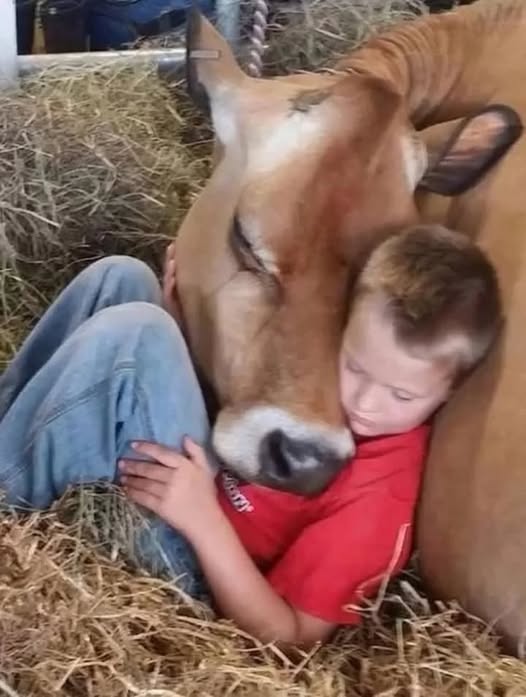
Seeing him curled against her broad, warm side is unsettling in a way that’s hard to explain. Our mother insists it’s harmless—a child finding comfort in an animal. My father waves it off as a temporary phase brought on by farm life and imagination. But I’ve always known better. Leo isn’t there out of affection. He’s hiding. The barn isn’t a preference—it’s a refuge.
A few nights ago, curiosity and unease pushed me to follow him. Once the house was dark, I slipped into the barn. The smell of hay and earth hung heavy in the air, broken only by the slow breathing of livestock. I stayed out of sight as Leo rested his head against Daisy’s neck. He didn’t know I was there. Then he whispered—quietly, urgently.
“I didn’t tell them it was me,” he said. “I know you saw. I know you remember. Thank you for not saying anything.”
Daisy didn’t react. She only blinked slowly, calmly, like a silent guardian. In that moment, I understood something deeply wrong. Leo wasn’t just avoiding his bed. He was choosing the only witness that could never speak.
The next day, I confronted him behind the grain silo. I expected resistance, maybe silence. Instead, he collapsed. His fear spilled out as relief, like he’d been holding his breath for weeks. He grabbed my hand tightly.
“Don’t open the red toolbox,” he begged. “And don’t show anyone the picture. Promise me.”
I promised—just to calm him—but the words followed me all day.
My father owns countless toolboxes scattered across the farm. It took hours of searching before I found the one Leo meant: an old red metal box hidden beneath the floor of the tool shed, buried under rotting burlap. The paint was chipped, the latch stiff with age.
Inside was a faded Polaroid photograph.
It showed the woods near the abandoned stone well at the edge of our land. The lighting was dim, the image grainy—but unmistakable. A figure stood near the opening, wearing Leo’s blue windbreaker. What lay at his feet made my stomach drop.
Beneath the photo were several items that didn’t belong to us: a single cufflink, unfamiliar car keys, and a small leather notebook with no name inside.
Suddenly, everything made sense.
Last fall, a hiker had gone missing in the nearby state park. There were searches. News coverage. Then silence. Authorities eventually stopped looking, blaming the size of the forest.
Leo hadn’t changed because he was growing up. He’d changed because he was carrying something no child should. He slept beside Daisy because she asked no questions. She offered warmth without judgment, presence without demand.
I sat there for a long time, the toolbox open, understanding that the truth had passed to me. I looked toward the barn, where Leo would soon return to his quiet vigil. Now I knew why the photo had to stay hidden. It wasn’t just evidence—it was the exact moment his childhood disappeared.
When I closed the toolbox and slid it back beneath the floorboards, I understood my role. I had become part of the silence. Another witness who wouldn’t speak. Another keeper of what was buried in the woods and sealed beneath our feet.
As I walked back to the house, the farm felt louder than ever—filled with all the things that would never be said again.