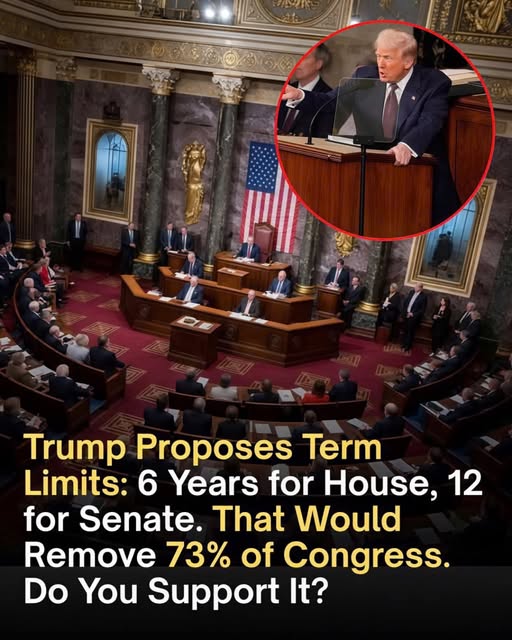
What started as a familiar “drain the swamp” message has rapidly ESCALATED into a high-stakes institutional signal that is now reverberating far beyond campaign rhetoric. In a stunning policy shift, Donald Trump is once again aligning himself with a proposal that would fundamentally reshape the structure of the U.S. Congress—limiting members of the House of Representatives to 6 years and Senators to 12. What was once a recurring talking point has now TRIGGERED renewed attention inside policy circles, where discussions are no longer hypothetical but increasingly framed as strategic groundwork.
In those circles, the mechanics alone are formidable. Conversations tied to constitutional amendments often require 50 to 100+ hours of legal drafting, advisory review, and iterative revisions before even approaching a formal proposal stage. Teams of constitutional scholars, legislative aides, and policy strategists typically engage in layered consultations—testing language, assessing precedent, and modeling political feasibility. While no official budget has been disclosed, analysts note that nationwide amendment efforts—when factoring in advocacy campaigns, legal teams, media strategy, and state-level coordination—can reach tens of millions of dollars over time. Even then, the process is far from guaranteed. At this stage, no formal amendment filing has been confirmed, positioning the current development as a SIGNAL of intent rather than an executed plan.
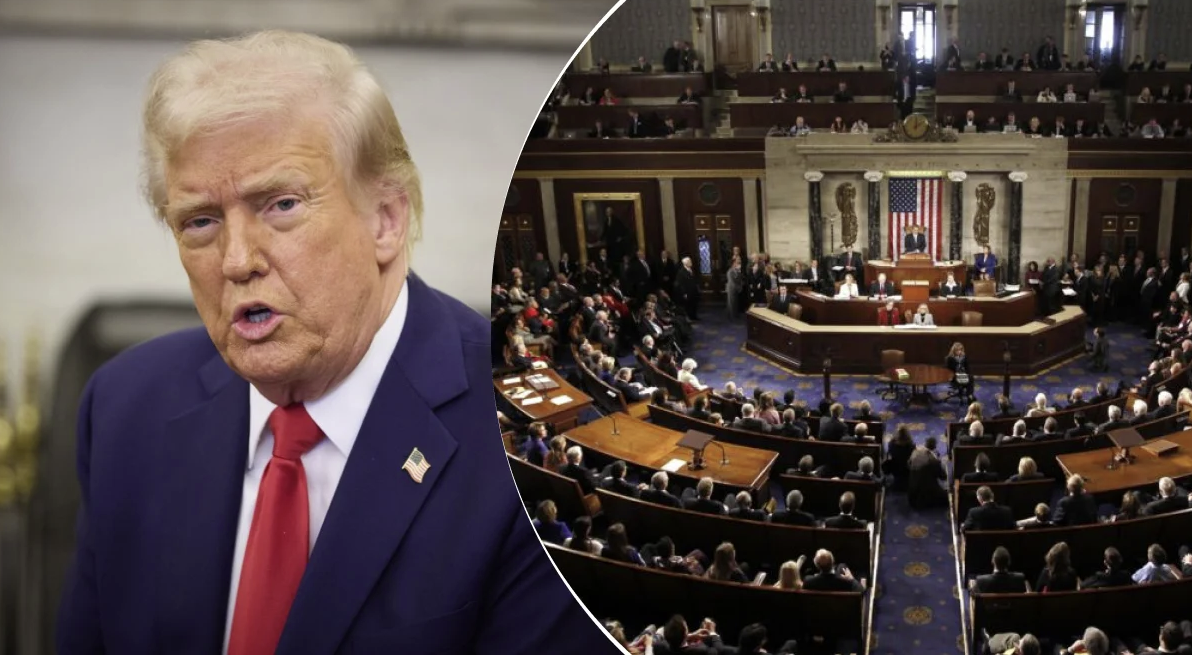
The proposal itself has IGNITED a deeper and more complex debate. On one side, supporters frame term limits as a structural reset—an instrument to reduce entrenched incumbency, increase turnover, and potentially realign Congress with shifting public sentiment. From this view, limiting tenure could inject new energy into legislative bodies and reduce long-term consolidation of influence. On the other side, critics and cautious observers point to the potential trade-offs. Institutional memory, policy continuity, and accumulated legislative expertise are often seen as stabilizing forces—particularly during periods of geopolitical or economic uncertainty. The question, then, is not just about rotation, but about balance: how to recalibrate power without eroding capacity.
Complicating matters further is the constitutional pathway itself. Any amendment would require approval by a two-thirds majority in both chambers of Congress, followed by ratification from three-fourths of U.S. states. This multi-stage process—spanning committees, debates, state legislatures, and potentially years of political negotiation—introduces layers of friction that make rapid implementation unlikely. Legal experts emphasize that even under aligned political conditions, constitutional amendments are among the most demanding mechanisms in governance. This reinforces the idea that the current moment is less about immediate change and more about positioning—about setting the terms of debate ahead of future electoral cycles.
Beyond Washington, the ripple effects are beginning to take shape. While financial markets have not directly reacted, governance-related uncertainty can sometimes SIGNAL broader caution among institutional observers. Investors, policy analysts, and global stakeholders often monitor such developments as indicators of potential shifts in legislative stability or regulatory continuity. Even without concrete action, the framing of systemic reform can influence expectations—particularly when it intersects with election timelines and broader policy agendas.
Behind the scenes, insiders suggest that the timing of this renewed push may be as significant as the proposal itself. Strategic advisors, advocacy organizations, and political operatives are likely assessing how the narrative of “term limits” can be integrated into a broader messaging framework—one that touches on reform, accountability, and long-term institutional trust. There are also indications that cross-party undercurrents may quietly shape how the idea evolves. While publicly framed as a bold structural shift, its eventual trajectory could involve negotiation, recalibration, or even partial adaptation into alternative legislative proposals.
Importantly, no final mechanism has been activated. No legislative text has been formally introduced. No binding vote has been scheduled. Yet the SIGNAL alone has been enough to ESCALATE discussion across political, legal, and public domains. Media cycles are amplifying the conversation. Analysts are modeling scenarios. And voters, increasingly, are being drawn into a debate that touches on the very architecture of representation.
At its core, this moment reflects a broader tension within modern governance: the push between continuity and disruption, between experience and renewal, between stability and reform. Term limits, while conceptually straightforward, sit at the intersection of these competing priorities. And as history has shown, structural changes of this magnitude rarely unfold quickly—or predictably.
For now, the proposal exists in a space between rhetoric and reality. But that space is narrowing as attention intensifies and expectations begin to form. Whether this evolves into a formal constitutional effort or remains a strategic signal tied to future campaigns, one thing is clear: the conversation is accelerating, and its implications are expanding well beyond a single policy idea.
