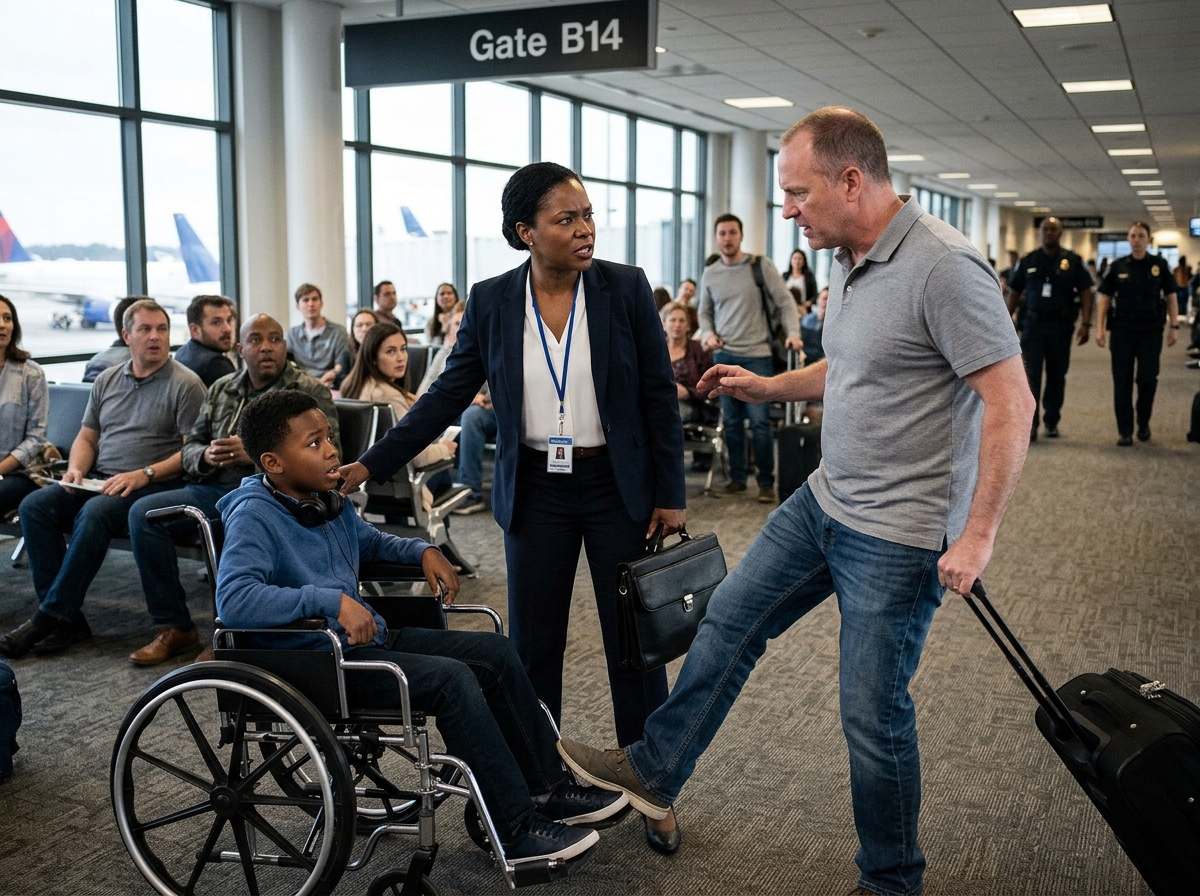
A White Passenger Kicked A Disabled Black Boy’s Wheelchair At Gate 14… Completely Unaware His Mother Was The Federal Judge About To Shut Down The Entire Airport.
He didn’t just bump into us. He planted his polished leather loafer against the battery housing of my ten-year-old son’s custom wheelchair and shoved it hard enough to rock the frame. “Keep your baggage out of the priority lane,” the man sneered. He had no idea who he was talking to.
Traveling with a disabled child is a masterclass in hyper-vigilance. You do not get to relax. You do not get to browse the magazine racks or lose yourself in a podcast while waiting for your flight. Your brain is a constant, churning radar system, scanning for uneven flooring, calculating the width of security checkpoints, and watching the body language of every single person in your immediate vicinity.
It was a Tuesday morning at Concourse B, Gate 14. The air smelled faintly of stale coffee and industrial floor cleaner. The morning rush was in full swing, a chaotic river of rolling luggage and stressed passengers trying to make their connections. I sat in a molded plastic chair near the boarding podium, my posture intentionally relaxed, my hands folded quietly in my lap.
Next to me was my ten-year-old son, Leo.
Leo is the brightest light in my life. He has cerebral palsy, which means his brain and his muscles do not always speak the same language. He cannot walk, and his verbal communication is limited to short phrases and the communication tablet mounted to his tray. He navigates the world in a Permobil F3, a three-hundred-pound marvel of steel, lithium batteries, and complex postural supports. It is not just a chair. It is his legs. It is his independence. It is an extension of his physical body.
Leo was currently oblivious to the stress of air travel. He had his tablet angled up, deeply engrossed in a game about building digital cities. Every few minutes, he would look up at the massive floor-to-ceiling windows, watching the baggage handlers toss suitcases onto the conveyor belts below. A wide, beautiful smile would spread across his face every time a plane pushed back from the gate.
“Big plane, Mama,” he said, his voice carrying that slightly strained, breathy quality I loved so much.
“Very big plane, baby,” I replied gently, reaching out to adjust the collar of his soft cotton shirt. “We’re going to get on ours very soon.”
We were flying out of state to see a pediatric orthopedic specialist. It was a critical appointment, one we had waited six months to get. The logistics of this trip had required military-level planning. I had spent hours on the phone with the airline’s accessibility desk, coordinating the gate-check procedure for his chair and ensuring we had the right seating assignments.
I checked my watch. We were ten minutes away from the pre-boarding announcement.
I pulled my phone from my trench coat pocket and dialed a familiar number. It rang twice before a deep voice answered.
“Vance. Tell me you aren’t delayed.”
“No delays yet, David,” I said softly, keeping my voice low so as not to disturb the people sitting nearby. “We are at the gate. Boarding in ten. Are the guys on your end set up?”
“Vehicle is waiting on the tarmac at the destination,” David replied. “They have the ramp van secured. You just text me when you touch down. Try to get some sleep on the flight, Clarice.”
“You know I don’t sleep on planes. I’ll text you from the runway.”
I hung up and slipped the phone away. A woman sitting across the aisle gave me a brief, dismissive look, probably assuming I was checking in with a boyfriend or a demanding husband. She had no way of knowing I had just been speaking to the Chief Deputy United States Marshal for my district, confirming my security detail for the arrival city.
I am the Honorable Clarice Vance. I sit on the federal bench for the United States District Court. I spend my days interpreting the law, presiding over complex civil rights cases, and sentencing individuals who have violated federal statutes. In my courtroom, my authority is absolute. When I speak, rooms fall silent. When I enter, people stand.
But out here, in the harsh fluorescent lighting of Concourse B, I was intentionally invisible. I was dressed down in a simple beige trench coat, dark slacks, and comfortable flats. I wore no jewelry besides my wedding band. When I am off the clock and traveling with my son, I actively suppress my professional identity. I do not ask for special treatment. I do not flash credentials. I want to blend in. As a Black woman navigating public spaces with a disabled Black boy, drawing attention usually invites unwanted friction. My goal is always to move quietly, smoothly, and safely.
I leaned back and did my habitual security scan of the area. It is a reflex you develop after your first few death threats from angry defendants. I noted the emergency exits. I noted the location of the nearest airport police kiosk two gates down. And I noted the black dome of a high-definition TSA security camera mounted directly above the Gate 14 podium, its tiny red light blinking steadily, recording every square inch of the boarding area.
Everything was orderly. Everything was calm.
Then, the atmosphere shifted.
You can always feel the exact moment when entitled energy enters a room. The ambient noise of the gate seemed to part, making way for a loud, sharp voice barking into a cell phone.
I turned my head. A man was striding toward the gate podium. He looked to be in his early fifties, wearing a charcoal grey suit that was clearly tailored, a crisp white shirt, and aggressive, pointed leather loafers. He was dragging a sleek black Tumi carry-on bag behind him.
“I do not care what the regional manager says,” the man yelled into his phone, his face flushed with impatience. “You tell them if that shipment isn’t cleared by customs by noon, I am firing the entire logistics team. I am not repeating myself. Fix it.”
He snapped the phone away from his ear and shoved it into his jacket pocket. He did not slow his pace as he approached the podium. He bypassed the roped-off line for standard boarding and marched directly into the designated priority lane, stopping inches from the counter.
Behind the podium stood Mateo Garza. I had read his nametag earlier when I checked in. Mateo looked young, maybe twenty-eight, with dark circles under his eyes and a uniform shirt that was slightly too large for his slender frame. He was currently typing furiously into his computer, trying to finalize the passenger manifest.
The man in the suit tapped his knuckles hard against the laminate surface of the podium.
“Excuse me,” the man demanded. “I need to board now. I have a conference call in twenty minutes and I need to get settled in first class.”
Mateo jumped slightly at the sharp sound. He looked up, his expression a mix of customer-service panic and sheer exhaustion.
“Good morning, sir,” Mateo said, his voice trembling just a fraction. “We haven’t quite begun the boarding process yet. The crew is just finishing their safety checks.”
“The plane is right there,” the man said, pointing a rigid finger at the window. “I am Diamond Medallion. You have my profile. Scan my pass and let me down the bridge. I don’t have time to stand around with the standby crowd.”
“I understand your status, sir,” Mateo said, trying to maintain a polite smile. “But FAA regulations require us to board passengers needing extra time and wheelchair assistance first. We will be calling pre-boarding in about two minutes. If you could just step back and wait for the announcement, I will gladly scan you in immediately after.”
The man’s jaw tightened. He looked at Mateo as if the young gate agent were a stain on his shoe. He let out a loud, exaggerated sigh of disgust and took a single step back, crossing his arms over his chest. He began aggressively tapping his foot.
I watched the interaction with the cold, analytical detachment of a jurist. I evaluate character for a living. I listen to testimonies, I watch micro-expressions, and I determine credibility. This man was projecting a very specific type of corporate arrogance. He was a man who believed his income bracket and his frequent-flyer status exempted him from the rules that governed ordinary citizens. He operated under the assumption that his time was infinitely more valuable than the time of anyone around him.
I shifted my focus back to Leo. My son was humming quietly to himself, placing a digital hospital next to a digital park on his screen.
“Almost time, Leo,” I whispered.
“Go on the plane,” Leo cheered softly.
The PA system crackled to life. Mateo picked up the microphone, clearing his throat.
“Good morning, passengers on Flight 482 to Boston. We are now ready to begin the boarding process. At this time, we invite any passengers requiring extra time down the jet bridge, as well as those traveling in wheelchairs or mobility devices, to come forward to the podium.”
I stood up. I smoothed the front of my trench coat and reached down to disengage the wheel locks on Leo’s Permobil.
“Alright, baby,” I said. “Here we go.”
The gate area was crowded. To get from our seating area to the ramp leading down the jet bridge, I had to maneuver Leo’s chair through a narrow bottleneck between the priority lane stanchions and the podium. It required precision driving, something I was very accustomed to.
I began to roll the chair forward. The motor hummed quietly.
The man in the grey suit was standing exactly in the center of the narrowest point of the pathway, his arms still crossed, blocking our access to the ramp.
I paused the chair about three feet away from him. I maintained a polite, neutral expression.
“Excuse me, sir,” I said clearly. “We just need to slide past you to board.”
The man looked down. He looked at me, taking in my plain clothes, my dark skin, my calm demeanor. Then he looked at Leo, taking in the specialized headrest, the joystick, the strapped feet.
There was no flicker of empathy. There was no polite shuffle to the side. There was only raw, unfiltered irritation that an obstacle had presented itself in his immediate line of sight.
“They called first class,” he snapped, not moving an inch.
“They called pre-boarding for mobility devices, sir,” I corrected him, my voice remaining perfectly level. “If you could just take one step to your left, we can get out of your way.”
The man rolled his eyes. He looked over my head toward Mateo at the podium.
“Are you going to manage your line, or do I have to do it for you?” he shouted at the gate agent.
Mateo looked terrified. “Sir, please, she needs to board first. It’s airline policy.”
The man let out a sharp breath through his nose. He didn’t step back. He didn’t step to the side.
Instead, he decided to force his way forward, determined to reach the scanner before we could enter the ramp.
He lunged toward the podium. But the gap between the stanchion and Leo’s chair was too small for him to pass without turning sideways. Rather than adjust his own body, he chose to adjust ours.
Without breaking stride, the man raised his right foot and violently kicked the heavy plastic battery housing over the front left wheel of Leo’s chair.
The impact was loud. It sounded like a hammer striking hollow plastic.
The force of the kick jolted the three-hundred-pound chair backward on its casters. The sudden, violent movement threw Leo hard against his chest harness.
Leo let out a sharp, terrified gasp, dropping his tablet. It clattered loudly against his footrest. His hands flew up, his body stiffening in a sudden spastic reflex caused by the shock.
Time in the terminal seemed to stop. The ambient hum of the airport faded into a dull roar in my ears.
I looked down at my son. His eyes were wide with panic, his breathing ragged as he tried to understand why his safe space had just been assaulted.
I did not scream. I did not curse. I did not throw my hands up in a display of maternal hysteria.
The temperature in my mind dropped to absolute zero. The protective mother vanished, immediately replaced by the federal magistrate. I cataloged the physical contact. Unprovoked battery. Intentional application of force. Target: a vulnerable minor.
I looked up at the man.
He had successfully squeezed past us and was now standing at the scanner, holding out his phone. He looked back at me over his shoulder, his face twisted in a sneer of supreme, untouchable confidence.
“Keep your baggage out of the priority lane,” he said.
I engaged the manual brake on Leo’s chair with a loud, metallic click. I placed one hand reassuringly on my son’s shoulder to ground him.
Then, I stood up to my full height, locked my eyes onto the man in the grey suit, and took a single step forward.
— CHAPTER 2 —
I did not raise my voice. I did not wave my hands. I did not perform any of the frantic, agitated motions that the world expects from a mother who has just seen her child attacked.
In my courtroom, I have learned that the loudest person is rarely the one holding the power. Power is still. Power is observant. Power lets the opposition hang themselves with their own excess rope.
I took one step forward, placing myself squarely between the front of Leo’s three-hundred-pound Permobil wheelchair and the man in the charcoal grey suit. I locked my eyes onto his.
“Did you just kick my son’s wheelchair?” I asked. My voice was pitched low, barely above a conversational murmur, but it carried clearly through the sudden, brittle silence of the boarding area.
The man paused by the boarding scanner. He seemed momentarily thrown by my absolute lack of hysteria. He was waiting for me to scream. He was waiting for me to become a spectacle, a stereotype he could easily dismiss. When I didn’t, his confusion rapidly curdled back into arrogant irritation.
“I nudged a piece of luggage that was blocking the priority lane,” he snapped, waving his hand dismissively toward Leo. “The concourse is crowded enough without people treating the boarding area like a parking lot. Now, get out of the way. I have a flight to catch.”
He turned his back to me, assuming the interaction was over because he had decreed it so. He thrust his phone toward the optical scanner on the podium.
As he shifted his weight, the heavy leather and brushed-steel luggage tag hanging from his black Tumi carry-on swung into full view under the fluorescent lights.
My eyes snapped to it, my brain automatically engaging the same hyper-focus I use when reviewing a dense evidentiary exhibit. The tag was not standard airline issue. It was a custom corporate marker, engraved with deep, precise lettering.
Diamond Executive. Richard Sterling. VP of Global Logistics, OmniCorp.
I read the text twice in the span of a single second, committing it to my permanent mental record. Richard Sterling. OmniCorp. A Fortune 500 tech and logistics firm with headquarters on the West Coast. A company that undoubtedly had a very strict, legally binding morality and conduct clause written into the contracts of its senior executives.
“Mr. Sterling,” I said quietly.
He froze. He hadn’t introduced himself. His head whipped back around, his eyes narrowing as he tried to figure out how I knew his name.
“That is not luggage,” I continued, my voice remaining perfectly flat. “That is a custom pediatric mobility device. It is legally classified as an extension of my son’s physical body. You did not nudge it. You applied violent, intentional physical force to it in order to clear your path. You committed a battery against a disabled minor.”
Richard Sterling let out a sharp, incredulous laugh. It was a harsh sound that scraped against the quiet hum of the terminal.
“A battery?” he scoffed, looking around to see if anyone else was appreciating the absurdity of my claim. A few passengers in the nearest row of seats were watching us, their expressions tight with discomfort, but none of them made a move to intervene. They simply averted their eyes when Sterling looked their way. “Listen to yourself, lady. You’re delusional. You’re weaponizing your kid’s condition to skip the standby line. It’s pathetic.”
He slammed his hand on the podium, startling the young gate agent, Mateo, who was still standing frozen behind the computer monitor.
“Scan the pass!” Sterling barked. “And call security to remove these disruptive standby passengers before I call your station manager and have you fired.”
Mateo looked like he was about to physically collapse. He was young, maybe twenty-eight, and the dark circles under his eyes spoke of chronic double shifts and a life lived on the absolute edge of financial ruin. He wore the standard blue airline vest, but it hung loosely on his narrow shoulders.
Mateo stepped out from behind the podium. He didn’t approach Sterling. He approached me.
He kept his head slightly bowed, his hands clasped nervously in front of his waist. He looked at me, then cast a quick, pained glance down at Leo, who was still breathing rapidly, his hands gripped tightly around the rubber armrests of his chair.
“Ma’am,” Mateo whispered, his voice trembling. “Please. I’m so sorry, but could you just… could you just roll the chair back a few feet? Just to the edge of the seating area?”
I looked at the young man. I could see the sweat beading on his forehead. I could see the faint tremor in his fingers.
“Mateo,” I said gently. “You called pre-boarding. We are entirely within our rights to be in this lane.”
“I know,” he pleaded softly, taking a half-step closer so Sterling couldn’t hear him over the ambient terminal noise. “I know you are. But he’s a Diamond Medallion. He flies a hundred thousand miles a year with us. If he files a formal complaint, the system automatically triggers a disciplinary review. Three write-ups and I lose my job.”
He paused, swallowing hard, his eyes briefly shining with unshed, humiliating tears. “I need the medical insurance, ma’am. My little sister… she needs the insurance. I can’t lose this job. Please. It’s just easier if you move back and let him go.”
My heart broke for him, even as my jaw tightened. This is exactly how men like Richard Sterling move through the world. They do not just rely on their own aggression; they rely on the terror of the working class. They use the precarious livelihoods of people like Mateo as a shield, knowing that the fear of poverty will force the vulnerable to enforce their entitlement for them.
Sterling wasn’t just bullying me. He had weaponized Mateo’s love for his sister against my right to board safely.
“Did you see him kick the chair, Mateo?” I asked, my tone softening into something almost maternal.
Mateo looked down at his scuffed uniform shoes. “I… I saw him try to squeeze by, ma’am.”
“Mateo,” I said, holding his gaze until he was forced to look up at me. “Did you see his foot make physical contact with the battery housing?”
The young agent hesitated for a long, agonizing second. Then, he gave a single, almost imperceptible nod. “Yes. But my hands are tied. Please, just move.”
I understood his fear. As a Black woman, I have spent a lifetime navigating the suffocating weight of systemic power imbalances. I knew exactly what it felt like to swallow your own dignity just to survive the shift. I was not angry at Mateo. He was collateral damage.
But I was not going to move.
“I am not going to jeopardize your employment, Mateo,” I said clearly. “But I am also not going to retreat.”
I turned my back on both Mateo and Sterling. I knelt down on the thin, patterned carpet of the terminal floor, placing myself at eye level with my son.
Leo’s spasticity had flared from the shock of the impact. His legs were rigid against the footplates, and his breathing was shallow.
“I’ve got you, baby,” I whispered, reaching out to stroke the side of his face. His skin was warm. “You are completely safe. Mama is right here. Nothing is going to hurt you.”
“Loud noise,” Leo managed to say, his voice strained.
“I know. It startled you. But the chair is strong, and you are strong.”
I ran my hands over the lower frame of the Permobil. The heavy plastic casing that housed the dual lithium batteries was situated directly above the front left caster wheel. I found the impact point immediately. There was a deep, white scuff mark etched into the dark grey plastic, accompanied by a faint hairline crack radiating outward from the center of the strike.
It was a superficial wound to a machine built like a tank, but the legal implications were absolute. In the eyes of the law, kicking a disabled person’s customized mobility equipment is legally indistinguishable from kicking the person’s actual leg.
I checked my watch. The digital display read 08:14 AM.
Without moving my head, I shifted my eyes upward. Directly above the boarding podium, suspended from a metal pipe attached to the ceiling, was a black, dome-shaped TSA security camera. A tiny red LED light pulsed steadily on its rim, confirming it was actively recording.
08:14:22 EST. Concourse B, Gate 14. Camera 4B.
I locked the metadata into my memory. The evidence was preserved in high-definition 4K video. It captured the angle, the intent, and the violent transfer of momentum. It captured the unprovoked nature of the strike. Sterling could lie to Mateo all he wanted, but he could not lie to the federal server housing that footage.
I stood back up. Sterling was still fuming at the podium, tapping his foot, holding his phone out.
“This is ridiculous,” Sterling muttered loudly to the empty air. “I’m calling the police.”
“That will not be necessary, sir,” a deep voice interrupted.
I turned. Two officers from the Airport Authority Police Department were striding down the concourse toward our gate. They were dressed in heavy dark blue uniforms, tactical vests strapped over their chests, radios crackling softly on their shoulders.
I recognized the dynamic immediately. Mateo hadn’t called them. Sterling had likely texted someone at the airline’s VIP desk while he was marching toward the gate, or he had caught the eye of a passing patrolman earlier and waved them over.
Sterling’s entire posture transformed the moment the officers arrived. The red-faced, barking corporate bully vanished in a millisecond. He smoothed the lapels of his charcoal suit, let out a long, long-suffering sigh, and adopted the composed, slightly weary expression of a reasonable man dealing with the chaotic public.
“Officers,” Sterling said, stepping away from the podium to meet them halfway. “Thank goodness you’re here. I apologize for the disturbance, but I’ve been trying to board my flight and this passenger has become completely unhinged.”
The two officers, a heavyset white man whose name badge read Miller, and a younger, athletic Black man named Davis, stopped at the edge of the boarding lane.
They looked at Sterling. They took in his pristine suit, his Diamond Medallion tag, his expensive leather bag, and his aura of practiced, corporate calm.
Then, they looked past him. They looked at me. A Black woman in a plain beige trench coat, standing next to a large, complicated medical device taking up a significant amount of floor space.
The implicit bias snapped into place so fast it almost made a sound. It was an algorithm written into the very fabric of American law enforcement. Wealth and whiteness signify order and credibility. Blackness and disability signify disruption and risk.
“What seems to be the problem here, sir?” Officer Miller asked, addressing Sterling directly, completely ignoring my presence.
“I was simply trying to access the priority lane,” Sterling lied smoothly, his voice a masterclass in calm, aggrieved patience. “I have a very important conference call and I need to get to my seat. I accidentally brushed against this woman’s luggage cart as I was squeezing past. It was a completely harmless brush. But she completely lost her mind. She started blocking my path, shouting at me, and making threats. She’s completely hysterical.”
It was a brilliant, terrifyingly effective inversion of reality. He didn’t just deny the assault; he projected his own aggression onto me. He used the word “hysterical,” a targeted trigger word designed to immediately categorize me as irrational and dangerous. He called Leo’s chair a “luggage cart,” stripping away the medical reality of the situation to make my defense of it seem absurd.
Officer Miller nodded sympathetically. He rested his right hand casually on his duty belt, just inches from his radio and his sidearm, and finally turned his attention to me.
“Ma’am,” Miller said, his voice carrying that flat, authoritative drone used to manage unruly crowds. “I’m going to need you to step away from the boarding area immediately.”
I stood my ground, keeping my hands clearly visible at my sides.
“Officer,” I said calmly. “That man did not brush past us. He intentionally kicked the battery housing of my son’s motorized wheelchair because we were in his line of sight. It was an unprovoked physical battery.”
Sterling chuckled. It was a warm, dismissive sound.
“A battery?” Sterling repeated, shaking his head at the officers as if to say, Can you believe this? “It’s a wheelchair, officers. It’s a piece of plastic. She’s trying to manufacture a federal case out of a crowded terminal just to get her way. She’s been holding up the entire boarding process.”
Officer Davis, the younger Black cop, glanced at Leo. He seemed to notice the spasticity in my son’s legs, the specialized headrest. I saw a flicker of hesitation in his eyes, a brief moment of internal conflict. But he said nothing. He deferred to his senior partner.
Miller sighed, clearly annoyed that I wasn’t instantly complying with his directive to disappear.
“Ma’am, I am not going to ask you again,” Miller said, taking a step closer to me, his sheer physical bulk designed to intimidate. “We cannot have a disturbance at an active gate. You are impeding the flow of commerce and creating a security issue. Now, I need your government-issued ID, and I need you to step back to the concourse wall right now, or you are not getting on this flight. Do you understand me?”
I looked at Officer Miller. I looked at the way his hand was resting on his belt. I looked at Mateo, who had completely retreated behind his computer monitor, staring blankly at the screen, too terrified to speak the truth.
And then I looked at Richard Sterling. He was standing slightly behind the officers, his hands resting easily in his pockets. He was smirking. It was a small, tight, victorious smile. He had successfully weaponized the police against me. He had used the exact systems designed to protect the public to enforce his own private entitlement.
He was entirely confident that he had won. He believed that I was just an ordinary, powerless woman who would be intimidated into silence by a badge and a threat.
I took a slow, deep breath, letting the icy calm of the bench wash away the last remaining traces of my civilian restraint.
“My ID,” I repeated softly.
“Yes, ma’am. Right now,” Miller demanded.
I reached into the deep pocket of my trench coat. My fingers brushed the smooth plastic edge of my state driver’s license. But they slipped past it, diving deeper into the lining of the coat, settling instead on the thick, gold-embossed leather folder resting at the very bottom.
I wrapped my fingers around the leather, feeling the heavy metal crest embedded in the cover.
I didn’t pull it out yet. I needed one more piece of the puzzle to fall into place before I locked the trap.
— CHAPTER 3 —
I left the heavy, gold-embossed leather folder resting at the bottom of my coat pocket.
My fingers lingered over the judicial seal for a fraction of a second before I deliberately bypassed it and pulled out my standard state driver’s license instead.
There is a principle in federal law, a procedural necessity regarding the exhaustion of local remedies. Before a higher court intervenes, you must allow the lower authorities the opportunity to do their jobs correctly. You have to give the system the chance to work. And more importantly, if you intend to dismantle someone for a civil rights violation or an assault, you must give them the opportunity to fully commit to their actions on the public record.
If I pulled out my federal credentials right then, the dynamic would instantly invert. Officer Miller would snap to attention. Sterling would likely backpedal, claiming he had no idea, offering some hollow, terrified apology to save his corporate skin. The incident would be swept under the rug of professional courtesy.
I did not want a terrified apology. I wanted Richard Sterling to face the actual, unshielded consequences of assaulting a disabled child. I needed to let him build his own gallows, and I needed to let Officer Miller hand him the rope.
I handed my plastic state ID to the heavyset officer.
Miller took it without looking at me. He held it up to the harsh fluorescent light, scrutinizing the laminate as if he suspected a middle-aged mother traveling with a pediatric wheelchair might be using a forged document. He pulled a small radio mic from his shoulder and keyed it.
“Dispatch, this is unit four. Running a check on a Clarice Vance. V-A-N-C-E.”
He read off my birthdate and my home address, broadcasting my personal information to anyone standing within twenty feet of the boarding podium. I felt the collective gaze of the waiting passengers heavy on my back. The terminal had grown uncomfortably quiet. People had stopped scrolling on their phones. They were watching the show. A Black woman being interrogated by the police at an airport gate is a spectacle that American culture has trained people to view with immediate, unquestioning suspicion.
I looked at Officer Davis, the younger Black officer standing two steps behind Miller. His eyes flicked down to Leo, then up to me. I saw the tight set of his jaw. He was observing the physical evidence. He saw the scuff mark on the Permobil’s battery housing. He saw the way Leo was trembling, his hands still locked in a spastic grip on the armrests. Davis knew exactly what had happened here. He knew that the immaculate white executive in the tailored suit was lying.
But Davis remained silent. His hands stayed clasped over his tactical vest. The brotherhood of the uniform, the hierarchy of the shift, and the unspoken rules of survival in law enforcement dictated that he defer to his senior white partner. I did not judge him for it. I understood the suffocating weight of institutional survival. But his silence cemented the reality of my situation. I was entirely on my own.
“Clear on the background,” the radio crackled back. “No active warrants.”
Miller sounded almost disappointed. He lowered his radio and looked at me, his expression hardening into a mask of bureaucratic irritation.
“Alright, Ms. Vance,” Miller said, his tone thick with condescension. “Here is how this is going to work. You are currently creating a disturbance at a secure boarding gate. Mr. Sterling here is a frequent flyer with this airline, and he has stated that you became aggressive and blocked his path after a minor, accidental contact.”
“I have already stated the facts, Officer,” I said, keeping my voice even, refusing to match his escalating volume. “It was not accidental contact. It was an intentional kick to a vital piece of medical equipment. If you simply request the footage from the TSA camera directly above your head, you will see the battery occur.”
Sterling let out a loud, theatrical groan. He looked at his heavy silver wristwatch and shook his head.
“Officers, please,” Sterling pleaded, sounding like a deeply reasonable man pushed to his absolute limit by a crazy person. “I have a board meeting in Boston at one o’clock. This is absurd. She is trying to extort some kind of upgrade or compensation by holding the entire flight hostage. I barely touched the plastic cart. Can we please just proceed with boarding? You can take her statement off to the side.”
He called it a plastic cart again. It was a deliberate, calculated linguistic choice designed to strip Leo of his humanity and reduce his complex, essential mobility device to the status of a forgotten piece of luggage.
Miller nodded sympathetically at Sterling. Then he turned his full, imposing bulk toward me.
“Ms. Vance, I am not going to pull security footage because you bumped into someone in a crowded line,” Miller warned, his voice dropping into a harsh, authoritarian register. “This is your final warning. If you do not move this chair out of the priority lane right now and cease this disruptive behavior, I will cite you for disorderly conduct. If I cite you, the airline has the legal right to deny you boarding. You will be placed on the internal no-fly list, and you will not be making your trip today. Do I make myself absolutely clear?”
The threat hung in the air, heavy and toxic.
It was the ultimate trump card of the American policing system when deployed against minority citizens. Comply with the injustice, swallow your dignity, and accept the abuse, or we will use the power of the state to completely destroy your day, your plans, and your freedom.
I looked over at Mateo. The young gate agent was staring fixedly at his computer screen, his face pale. He was terrified of losing his health insurance. He was terrified of the Diamond Medallion complaint process. He had completely abandoned us to the wolves.
“Should I just…” Mateo stammered, his voice cracking. He looked up at Officer Miller, seeking permission. “Should I just board Mr. Sterling now? Just to clear the lane and get the process started? The flight crew is asking for an update on the delay.”
Miller waved his hand. “Yes. Scan his pass. Let him through. Get him out of here.”
Sterling’s smirk returned, a triumphant, razor-thin line across his face. He had won. The system had functioned exactly as he expected it to. His wealth, his whiteness, and his aggressive confidence had seamlessly mobilized the local police to act as his personal security detail, clearing the inconvenient Black woman and her disabled child out of his path.
He didn’t even look at me as he stepped up to the podium. He slapped his phone against the optical scanner. It emitted a bright, cheerful beep.
“Thank you, officers,” Sterling said smoothly. “I appreciate you handling the situation.”
He grabbed the handle of his Tumi bag. He turned toward the ramp leading down the jet bridge.
He was leaving. The man who had physically assaulted my child, who had damaged a piece of medical equipment worth more than a luxury car, was simply going to walk down a carpeted hallway, sit in a wide leather seat, drink a pre-flight mimosa, and disappear into the sky. The local police were actively facilitating his escape.
“Mama.”
The word was a fragile, broken breath.
I looked down. Leo was crying. He is a boy who endures hours of painful physical therapy with a smile, a boy who faces the daily frustrations of a body that will not obey him with incredible grace. But he was crying now. Tears were spilling over his dark eyelashes, tracing wet paths down his cheeks.
He looked at the police officers. He looked at the angry passengers in the seating area. Then he looked at the open door of the jet bridge where Sterling had just disappeared.
“My fault?” Leo whispered, his voice trembling violently. “Chair in the way? Miss the doctor?”
He thought he had caused this. He thought his existence, his need for space, his heavy chair, had made the police angry. He thought he was the reason we were going to miss the specialist appointment we had waited six months for. The appointment that could determine if he needed another spinal surgery.
My heart did not just break in that moment. It hardened into something cold, dense, and utterly unforgiving.
This was the dark night. This was the bottom of the well.
I stood in the center of the terminal, surrounded by people, yet completely isolated. The social contract was fully exposed as a fraud. The rules of public decorum, the procedures of law enforcement, the policies of the airline, they were all flexible, malleable constructs designed to bend around the desires of a man like Richard Sterling.
If I remained Clarice Vance, the quiet, compliant civilian mother, I would have to kneel on this dirty carpet, wipe the tears from my son’s face, tell him that the bad man was allowed to win, and pray that Officer Miller would graciously allow us to board the plane and sit in the back. I would have to teach my son that his safety did not matter, that his body was an acceptable target for corporate frustration.
I could not do it. I would not do it.
I watched Officer Miller flip his notepad closed. He held my driver’s license out to me, pinching it between two fingers like it was something unclean.
“Take your ID, Ms. Vance,” Miller ordered. “Move the chair. Sit down until they call the end of the line. This is over.”
I did not reach for the card.
The air in my lungs felt remarkably clear. The chaotic noise of the terminal, the static of the police radio, the hum of the boarding scanner, it all faded into a sharp, crystalline focus.
I looked at the black dome of the security camera above the podium. It was still recording.
I looked at Officer Miller. I looked at Officer Davis. I noted their badge numbers, their names, and the exact positions of their body cameras.
The local jurisdiction had officially failed. They had refused to investigate a reported battery. They had threatened the victim with arrest. And they had explicitly authorized the suspect to flee the scene and board a commercial aircraft.
The puzzle was complete. The trap was fully armed. The requirement to exhaust local remedies had been met, documented, and witnessed by fifty people.
“Officer Miller,” I said. My voice had changed. The civilian warmth was gone. The mother’s plea was gone. What replaced it was the flat, resonant, unmistakable cadence of the federal bench. It was the voice I use when I am about to deliver a ruling that will alter the course of a person’s life.
Miller stopped. He frowned, clearly confused by the sudden shift in my tone. The woman standing in front of him no longer sounded like a frightened passenger. She sounded like a commanding officer.
“I need you to clarify something for the record before we proceed,” I said slowly, enunciating every single syllable with terrifying precision. “Are you officially refusing to take a formal report of battery, and are you officially authorizing the suspect, Richard Sterling, to leave this jurisdiction by boarding that aircraft?”
Miller’s face flushed red. His hand moved back to his belt. “I told you, lady, this is over. Take your ID and move.”
“Answer the question, Officer Miller,” I demanded, the sheer force of the command causing Officer Davis to actually take a half-step backward in surprise. “Are you refusing the report and authorizing his departure?”
“Yes!” Miller barked, losing his temper completely. “Yes, I am. Because no crime was committed. Now take your ID or I am putting you in cuffs right now.”
“Thank you,” I replied softly.
I reached out and took my plastic state driver’s license from his fingers. I slid it into the side pocket of my trench coat.
Then, I reached into the deep inner lining of my coat. I wrapped my fingers around the thick, heavy leather of my judicial credentials.
I closed my eyes for a fraction of a second. I thought about the ducks Leo loved to feed at the park back home. I thought about the peace we had built. And I knew I was about to set fire to all of it in order to protect him.
I opened my eyes, gripping the gold crest, and made my decision.
— CHAPTER 4 —
I kept my hand buried deep inside the lining of my trench coat. My fingers traced the cold, heavy brass edge of the seal embedded in the leather folder.
I did not pull it out immediately. First, I needed to secure the perimeter. I needed to ensure that the trap was not just sprung, but that it was utterly inescapable.
While Officer Miller had been busy broadcasting my home address over his unencrypted shoulder radio, treating me like a common vagrant, my left hand had been resting quietly in my opposite pocket. My thumb had recognized the familiar tactile shape of my smartphone. Without ever breaking eye contact with the hostile police officer, I had used biometric touch to unlock the screen. By memory, I tapped the messaging icon, opened my pinned thread with Chief Deputy U.S. Marshal David, and typed three words without looking: Gate 14. Now.
For a Chief Deputy managing the protection detail of an active federal judge, a text like that is not a casual update. It is a distress flare. The United States Marshals Service does not wait for clarification. They move. I knew David’s local airport task force—the plainclothes detail stationed in the secure offices just one level above Concourse B—was already sprinting down the maintenance stairwells.
I had given the local jurisdiction every possible chance to do the right thing. I had presented them with a clear victim, a clear suspect, and clear evidence of a battery. I had remained polite, compliant, and de-escalatory.
And in return, Officer Miller had threatened to arrest me and had explicitly authorized the man who assaulted my disabled child to board a commercial flight and flee the state.
“I am waiting, Ms. Vance,” Miller barked, his face flushed with the impatient, aggressive heat of a man whose authority was not being respected fast enough. He took another step toward me, his hand fully gripping the butt of his radio, his body language deliberately expansive and intimidating. “You either move that chair out of the boarding lane this second, or I am putting you in handcuffs for disorderly conduct and interfering with airport operations. This is not a debate.”
Officer Davis, the younger Black cop, shifted his weight uncomfortably behind Miller. “Hey, man,” Davis muttered softly, trying to de-escalate his partner. “She’s just… let’s just get the supervisor down here.”
“No supervisor,” Miller snapped, his eyes locked on me. “She’s moving right now. Take your ID out of your pocket, put your hands where I can see them, and step back.”
“You are absolutely right, Officer Miller,” I said. My voice was no longer the quiet, careful murmur of a civilian mother trying to avoid a scene. It had dropped an octave. It had taken on the resonant, razor-sharp cadence that echoes off the mahogany walls of my courtroom. “This is not a debate.”
I pulled my hand out of my trench coat pocket.
I did not produce my plastic state driver’s license.
Instead, I withdrew the thick, dark navy leather credentials wallet. I held it up between us, right at Miller’s eye level. With a flick of my wrist, I flipped it open.
The harsh fluorescent lights of the terminal caught the brilliant, polished gold of the United States District Court seal pinned to the top half of the leather. Below it, secured behind a thick sheet of clear vinyl, was my federal identification card, complete with my photograph, the seal of the Department of Justice, and the bold, capitalized text of my commission.
Officer Miller’s brain did not process what he was looking at immediately. He was so deeply entrenched in his assumption of my powerlessness that he thought I had pulled out a decorative wallet or a corporate ID. He squinted at it, his mouth half-open, a snide remark already forming on his lips.
Then, his eyes focused on the words United States Government.
Then, they dropped to the words Article III Judge.
I watched the exact, microscopic moment his reality shattered. It was physical. The aggressive flush of red drained out of his cheeks with such violent speed that he looked suddenly jaundiced. His jaw went slack. The hand resting on his duty belt twitched, then slowly, rigidly, dropped to his side as if the plastic of his radio had suddenly become red-hot.
“Read it,” I commanded, my voice slicing through the ambient noise of the boarding area like a scalpel.
Miller swallowed hard. His vocal cords seemed paralyzed.
“I said, read the title, Officer,” I repeated, stepping one inch closer to him, forcing him to hold his ground or retreat.
“United… United States District Judge,” Miller stammered, his voice suddenly breathless and thin. “Honorable Clarice Vance.”
Officer Davis leaned over Miller’s shoulder, his eyes widening to the size of saucers as he took in the gold seal. A sharp, audible hiss of air escaped Davis’s teeth. He immediately took two full steps backward, physically distancing himself from his partner’s catastrophic error.
“That is correct,” I said, snapping the leather credentials closed with a sharp, authoritative crack that made Miller flinch. I slipped the folder back into my pocket. “I sit on the federal bench for the United States District Court. Which means I am a federal official. Which brings us to the precise legal nature of what just occurred at this podium.”
I kept my eyes locked on Miller. I did not raise my voice, but the sheer, dense weight of my tone caused the passengers in the immediate vicinity to fall completely silent. Phones that had been casually scrolling were slowly lowered. People were leaning in. The theater of the terminal had shifted.
“Five minutes ago,” I continued, my articulation flawless, “a man named Richard Sterling intentionally and violently kicked the mobility device belonging to my son. In the eyes of the law, a motorized wheelchair is an extension of the disabled individual’s physical body. That makes the act an unprovoked physical battery against a minor.”
Miller opened his mouth to speak, to offer some pathetic, backpedaling defense, but I cut him off instantly.
“Do not interrupt me,” I warned. The air temperature in the gate area felt like it had dropped ten degrees. “Under normal circumstances, that is a local misdemeanor. However, because I am a sitting federal judge, and this child is my immediate blood relative, Mr. Sterling’s actions trigger Title 18 of the United States Code, Section 111. Assaulting, resisting, or impeding a United States official, or assaulting the immediate family member of a United States official with the intent to intimidate or interfere with the performance of their duties.”
I let the statute hang in the air. The silence was deafening.
“That is not a local misdemeanor, Officer Miller,” I stated, delivering the killing blow. “That is a federal felony. It carries a maximum sentence of eight years in federal prison. And you—acting under the color of law—just actively refused to investigate that federal felony, threatened the victim’s mother with false arrest, and officially authorized the suspect to board a commercial aircraft to flee the jurisdiction.”
Miller looked like he was going to vomit. The sheer, overwhelming scale of his liability was crashing down on his head. He had tried to bully a Black woman to appease a wealthy white executive, and he had accidentally walked straight into the propeller of the federal justice system.
“Your Honor,” Miller choked out, his hands fluttering nervously in front of his chest, a complete reversal of his prior aggressive posture. “Your Honor, I swear to God, I didn’t know. He… the suspect told me it was an accident. He said he brushed against the cart. I was just trying to maintain order at the gate.”
“Ignorance of my title does not excuse your failure to investigate a battery,” I replied coldly. “You did not ask for my statement. You did not look at the physical damage to the wheelchair. You did not interview the gate agent. You took one look at a man in a bespoke suit, and one look at a Black woman with a disabled child, and you made a jurisdictional ruling based entirely on your own implicit bias. You are a disgrace to that badge.”
“Ma’am… Judge Vance,” Officer Davis interjected, stepping forward with his hands raised in a gesture of pure surrender. “What do you need us to do? Tell us what you need.”
“What I need, Officer Davis, is for you to step aside,” I said, glancing past him down the concourse. “Because your jurisdiction over this matter ended the moment you let that man on the plane. The federal government is taking over.”
As if summoned by the sheer force of the invocation, the heavy, rhythmic sound of boots hitting the terminal floor cut through the quiet.
The crowd of passengers near the seating area parted like the Red Sea.
Four individuals were moving toward Gate 14 at a highly synchronized, aggressive tactical jog. They were dressed in dark tactical cargo pants and heavy boots. Over their chests, they wore dark windbreakers with large, bold yellow lettering across the back and front: U.S. MARSHAL. They wore earpieces, and their duty belts were heavily armed.
At the front of the formation was Deputy Marshal David Hayes. He was a towering, broad-shouldered man with a shaved head and eyes that scanned the terminal with predatory efficiency.
They bypassed the priority lane stanchions completely, ignoring the stunned passengers. David locked eyes with me, his hand resting on his radio.
“Judge Vance,” David said, his voice a deep, gravelly bark that commanded instant obedience. He came to a halt two feet away from me, his three deputies fanning out instantly to secure the perimeter of the podium. “Are you and Leo secure?”
“We are physically uninjured, David,” I replied, my voice steady. “But my son’s medical equipment was just assaulted, and the suspect was permitted to board the aircraft.”
David’s eyes flicked to Officer Miller and Officer Davis. The two local airport cops looked like they wanted the floor to swallow them whole. In the hierarchy of law enforcement, local airport police are the absolute bottom of the food chain compared to the United States Marshals Service.
“Who authorized the suspect to board?” David demanded, stepping into Miller’s personal space. The size difference was intimidating; David loomed over the heavyset local cop.
“I… we…” Miller stammered, sweating profusely. “We believed it was a minor civil dispute, Deputy. We were trying to clear the gate.”
“You authorized a suspect in a federal assault case to board an FAA-regulated aircraft?” David asked, his tone dripping with absolute disgust. He didn’t wait for an answer. He turned his back on Miller, dismissing him entirely, and looked at me. “Give me the target, Your Honor.”
“Richard Sterling,” I said clearly, ensuring every word was caught on the body cameras of the local police and the overhead TSA camera. “He is seated in the first-class cabin of Flight 482. He is wearing a charcoal grey suit and carrying a black Tumi bag. He committed an unprovoked battery against my son, in violation of 18 U.S.C. Section 111.”
David keyed the microphone attached to his collar. “Command, this is Team Alpha. We have a confirmed 111 violation at Gate 14. Suspect is aboard Flight 482. Lock down the jet bridge. Do not let that aircraft push back from the gate. I say again, ground the aircraft.”
Behind the podium, Mateo Garza let out a small, terrified gasp. The young gate agent had been frozen in place for the last ten minutes, watching the nightmare unfold. He was staring at the computer screen, which was now flashing red with a ground-stop alert from the tower.
“The… the captain is asking what’s going on,” Mateo whispered, his hands hovering over the keyboard.
I looked at Mateo. The terror in his eyes was palpable. He still feared for his job. He still thought Richard Sterling’s Diamond Medallion status could ruin his life.
“Mateo,” I said gently, ensuring my tone was completely devoid of the wrath I had directed at Miller. “Mr. Sterling is no longer your customer. He is a federal suspect. You do not have to protect him anymore. Open the secure door for the Marshals.”
Mateo swallowed hard. He looked at the four heavily armed federal agents. He looked at the sweating local cops. And then, he looked down at my son, Leo, who was still gripping his armrests, his eyes wide but the tears finally stopping.
A flicker of courage finally broke through the young man’s exhaustion. Mateo reached under the podium and hit the heavy red override button. The heavy security doors leading to the jet bridge unlocked with a loud electronic clack.
“Doors are open, sir,” Mateo said to David, his voice trembling but resolute.
“Two and Three, with me,” David barked, gesturing to his deputies. “Four, hold the gate with the Judge. Nobody in, nobody out.”
David and two of the Marshals ripped open the doors and charged down the carpeted ramp of the jet bridge. The sound of their heavy boots echoed up the enclosed tunnel, a terrifying drumbeat of impending accountability.
While they were gone, the airline’s station manager arrived. He came sprinting down the concourse, a middle-aged man in a tailored navy suit, clutching a walkie-talkie and looking absolutely frantic. A grounded flight during the morning rush hour is a logistical nightmare that costs an airline tens of thousands of dollars per minute.
He burst through the crowd and zeroed in on Officer Miller. “What the hell is going on here? Why is the tower telling me the FBI just grounded my plane?”
“Not the FBI,” I corrected smoothly, stepping into his line of sight. “The United States Marshals Service.”
The station manager stopped dead in his tracks, his eyes darting from me, to the Marshal standing guard at the door, and then finally to the gold crest I had left exposed on the outside of my coat pocket.
“I am Judge Clarice Vance of the United States District Court,” I said, offering him no room to breathe. “And your airline just facilitated the escape attempt of a man who committed a federal felony against my child at this podium.”
The manager’s face went completely white. “Judge… Your Honor, I… I had no idea. We can get you on the next flight, we can upgrade you—”
“I do not want an upgrade, Mr. Manager,” I said, my voice lethal in its calm. “I want evidence preservation. Look directly above you.”
The manager obeyed, his eyes tracking up to the black dome of the TSA security camera mounted to the ceiling pipe. The tiny red LED light was still pulsing.
“That is Camera 4B,” I stated. “As a sitting federal magistrate, I am issuing an immediate, verbal spoliation hold and preservation injunction on the footage from that camera, from zero-eight-hundred hours to present. If that footage is mysteriously corrupted, accidentally deleted, or overwritten by your IT department, I will personally draft a bench warrant for your arrest for destruction of federal evidence and obstruction of justice. Do you understand my order?”
“Yes, Your Honor!” the manager practically shouted, scrambling for his radio. “Yes, absolutely. I’m calling IT right now. The footage is locked.”
“Good,” I said softly. “Because here comes the star of the film.”
From deep inside the jet bridge, a voice began to echo. It was loud, indignant, and dripping with outraged privilege.
“Take your hands off me! I demand you release me this instant! Do you know who I am? I am a Diamond Medallion! I have a board meeting in Boston! You cannot do this!”
The heavy doors at the top of the ramp swung open violently.
Richard Sterling emerged.
He was no longer striding with the confident, aggressive swagger of an untouchable corporate titan. He was being physically dragged up the incline by two United States Marshals. His immaculate charcoal grey suit jacket was bunched up around his shoulders. His arms were wrenched forcefully behind his back, and his wrists were locked in heavy, double-hinged steel handcuffs.
David Hayes followed closely behind him, carrying Sterling’s sleek black Tumi bag in one hand.
The entire gate area—over a hundred passengers, the flight crew standing nearby, the local police—watched in absolute silence as the wealthy executive was paraded out of the tunnel like a common criminal.
Sterling was thrashing against the Marshals’ grip, his face purple with rage. “This is an outrage! My lawyers will have your badges by the end of the day! I merely brushed past some woman’s luggage cart!”
The Marshals hauled him to a stop directly in front of the podium.
Sterling jerked his head up, preparing to scream another threat.
And then, he saw me.
He saw me standing there, not cowering, not crying, not pleading with the local police. He saw the local officers standing silently, terrified, in the background. He saw the airline station manager sweating profusely and refusing to make eye contact with him. He saw the fourth Marshal standing protectively near Leo’s wheelchair.
And finally, his eyes dropped to the heavy leather folder in my hand, the gold seal gleaming under the lights.
“Hello again, Mr. Sterling,” I said softly.
Sterling stopped struggling. The breath seemed to leave his lungs all at once. He stared at the seal, his mind desperately trying to catch up to the catastrophic reality of his situation. The arrogant sneer melted off his face, replaced by a look of sheer, unadulterated horror.
“You…” Sterling whispered, his voice cracking. “You’re…”
“I am the woman whose baggage you told to stay out of the priority lane,” I said, my voice carrying clearly across the silent gate. “I am also an Article III Judge for the United States District Court. And that ‘luggage cart’ you kicked is the customized medical equipment of my son, which makes your little tantrum a violation of federal law.”
Sterling’s legs literally gave out. If the two Marshals hadn’t been holding him up by his biceps, he would have collapsed onto the carpet.
“I… I didn’t know,” Sterling gasped, his eyes darting frantically around the room, looking for an ally, looking for anyone to save him. He looked at Officer Miller. “Tell them! Tell them it was a misunderstanding!”
Miller looked away, staring fixedly at the wall. He wanted absolutely nothing to do with Richard Sterling anymore.
“Of course you didn’t know,” I replied, stepping closer, allowing the full weight of my disgust to bleed into my words. “Because men like you never bother to look at the people you step on. You thought my son was invisible. You thought I was powerless. You thought your frequent-flyer status and your tailored suit gave you the right to inflict violence on a disabled child simply because we occupied the space you wanted.”
I reached out and pointed a perfectly manicured finger at the heavy leather and steel luggage tag hanging from the Tumi bag in Deputy David’s hand.
“Richard Sterling,” I read aloud, my voice ringing with judicial finality. “VP of Global Logistics at OmniCorp. A publicly traded Fortune 500 company. I am intimately familiar with OmniCorp’s corporate bylaws, Mr. Sterling. Specifically, the morality and conduct clauses required for your executive compensation packages.”
Sterling squeezed his eyes shut. A low, wretched moan escaped his throat. He knew exactly what I was talking about.
“When the United States Attorney’s Office formally unseals your federal felony indictment for assaulting a disabled minor, that indictment becomes public record,” I explained methodically, dismantling his entire life right in front of him. “OmniCorp’s board of directors will be notified immediately. They will not protect you. They will sever your contract to protect their stock price. You are not going to your board meeting in Boston today, Mr. Sterling. You are going to a federal holding cell. And when you finally bond out, you will find that you no longer have a career, a reputation, or a corporate title to hide behind.”
Sterling opened his eyes. They were wide, red-rimmed, and filled with tears of pure panic. The bully had been utterly broken.
“Please,” Sterling begged, his voice dropping to a pathetic, trembling whisper. “Please, Your Honor. I’m sorry. I’m so sorry. I’ll pay for the chair. I’ll do whatever you want. Please don’t do this. My whole life…”
“Your life is the consequence of your actions,” I said coldly. I looked at Deputy David. “Get him out of my sight.”
“Move,” David barked, shoving Sterling forward.
The Marshals marched the weeping, handcuffed executive through the crowd. The passengers, the same ones who had watched me with suspicion twenty minutes earlier, now pulled out their phones, snapping photos and recording video of the Diamond Medallion being hauled away in disgrace.
I turned my back on him before he even cleared the gate area.
I looked down at Mateo, the young gate agent. He was staring at me with a mixture of shock and profound awe.
“Mateo,” I said, my voice softening back into the gentle tone of a mother. “Nobody is going to write you up today. Your job is entirely safe.”
Mateo nodded rapidly, wiping a tear from his own eye. “Thank you, ma’am. Thank you, Your Honor.”
I turned away from the podium and walked back to where Leo was sitting in his chair. He was clutching his communication tablet, watching the door where the Marshals had disappeared.
The adrenaline was finally beginning to ebb, leaving a cold, metallic ache in my muscles. My hands were shaking, just slightly, the physical toll of holding the line.
I knelt down on the carpet, uncaring about the dust, and placed my hand firmly over the deep scuff mark on the plastic battery housing of the Permobil. I looked up into my son’s beautiful, wide eyes.
“Are we going to jail, Mama?” Leo asked softly.
I smiled. It was a fierce, protective, and completely exhausted smile. I reached up and smoothed his hair back from his forehead.
“No, baby,” I whispered, resting my forehead gently against his knee. “We aren’t going to jail. And we aren’t going to miss the doctor, either. Our plane is waiting.”
